Custom Software Development in Mumbai: Build or Buy, and What It Actually Costs
By Ayush DubeyNovember 15, 202613 min read
Short answer: Buy off-the-shelf software when your process is standard. Build custom software when your process is the advantage — or when the ready-made tool forces your team to work around it every day. In Mumbai, custom software typically takes 8 to 24 weeks and costs roughly Rs 2.5 lakh to Rs 30 lakh. This guide covers the build-vs-buy decision, the 7 checks before you sign, 2026 cost ranges, and what happens after launch.
The clinic that bought three tools and still used a notebook
A dental clinic chain in Vashi spent a year learning the hardest lesson in custom software development in Mumbai: it bought a billing package, a separate appointment tool, and a patient-record system, and none of them talked to each other. The receptionist copied patient names from one screen to another, the doctor kept follow-ups in a notebook, and the owner checked three dashboards to answer one question: how many patients came back this month?
The clinic was not short of software. It was short of software that matched how it actually worked. That is the moment the question stops being a luxury and starts being a practical one: do we keep bending our work around ready-made tools, or do we build something that fits?
Build or buy — the decision in plain language
Off-the-shelf software is built for thousands of businesses at once. It is cheaper to start, faster to switch on, and somebody else maintains it. If your process is standard — send invoices, book appointments, track stock the way everyone else does — a ready-made product is usually the right answer.
Custom software is built for one business. It costs more, takes longer, and you own the maintenance. It is the right answer when one of these is true:
Your process is your advantage. A logistics firm in Bhiwandi that dispatches trucks by rules no standard tool understands. A jeweller in Zaveri Bazaar whose billing, hallmarking and credit terms do not fit any standard package. When the way you work is what makes you different, a standard tool will flatten that difference.
You are paying the workaround tax. If your team exports data to a spreadsheet every day or re-enters the same information twice, add up those hours. A team of five losing one hour a day each loses roughly 130 working hours a month — often more than the monthly cost of maintaining a custom system.
You need your tools to talk to each other. Your billing, your WhatsApp messages, your website and your stock register should share one record of the customer. Ready-made tools sometimes connect; often they do not, or the connection costs extra every month.
A useful rule: if a ready-made tool covers 90 percent of what you need and the missing 10 percent is a minor inconvenience, buy it. If it covers 70 percent and the missing 30 percent is your daily work, build it — or build the missing piece and connect it to the product you already use.
Custom software development in Mumbai: how the process actually works
Custom software sounds mysterious. In practice it follows the same five stages every time, and knowing them stops you overpaying or ending up with half a system.
Stage 1: Scoping. The developer sits with your team and maps what actually happens today — not what the brochure says, but who does what, in which order, and where it breaks. A good scoping session ends with a written list of features, screens and users. If a developer quotes a price without scoping, the quote is a guess.
Stage 2: Design and prototype. Screens are drawn before code is written, so your team can see the system and object to it while changes are still cheap. A clinic receptionist should be able to book a patient in three clicks; a warehouse manager should find a stock level without a training session.
Stage 3: Build in pieces. The system is built in small working pieces — login and users first, then billing, then reports — and each piece is shown to you as it is finished. You should see working software within the first three to four weeks, not a finished surprise after six months.
Stage 4: Testing and training. Your own team tests it with real data before launch. The awkward cases surface here: the patient with two phone numbers, the order that is half-paid, the product with no barcode. Fix them now, not after launch.
Stage 5: Launch and support. The system goes live, usually alongside the old way of working for a week or two, while the developer stays close as your team settles in.
The 7 checks before you sign anything
1. Has the developer written down exactly what will be built?
A fixed quote is only fixed if the scope is written down: the features, the screens, the number of user roles, and what counts as finished. Ask for the scope document before you sign.
2. Do you know who owns the code and the data?
This matters more than the price. Your contract should say, in plain words, that you own the source code, the database and the data — and that you receive a full copy at handover. If the developer will not put that in writing, walk away.
3. Is the quote fixed, or time-and-materials?
A fixed quote suits a well-scoped project: you pay an agreed amount for an agreed scope, and changes are quoted separately. Time-and-materials suits a project that will genuinely evolve, but it needs a weekly report of hours spent.
4. Will it run on your phone, or only on a desktop?
In Mumbai, your staff, your delivery team and often your customers are on phones. A system that only works well on a desktop computer in the office will be ignored in the field. Ask to see the system on a phone before you approve the design.
5. Does it connect to the tools you already use?
Your software should not be another island. Ask how it connects to WhatsApp for customer messages, to your payment gateway, to your accounting package, and to your website. WhatsApp automation is the connection Mumbai businesses ask for most — order updates, appointment reminders and payment links sent automatically — because that is where the customer already is.
6. What happens when something breaks at 7 PM?
Software breaks. The question is how fast it gets fixed and who answers the phone. A support agreement should state response times and what counts as urgent, and whether support is included for the first three months or charged separately.
7. Can you see something working in the first month?
Ask for a delivery plan with dates: what you will see in week 3, week 6 and week 10. A developer who cannot show working software in the first month is either not building yet or building the wrong thing.
MVP or full platform — start small on purpose
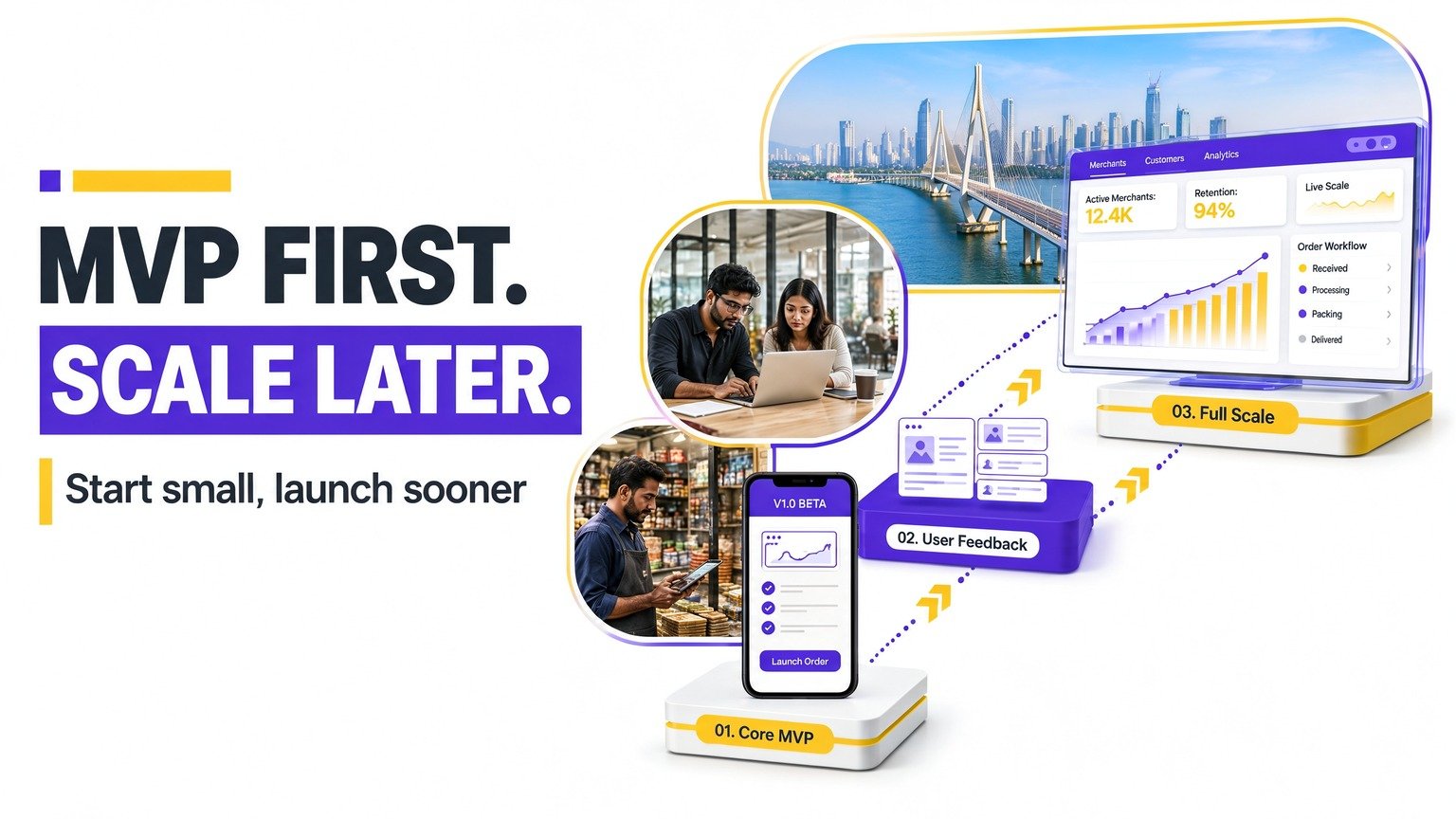
The most common mistake in custom software is trying to build everything in version one. The smarter route is a minimum viable product — the smallest version that does the core job properly — used by your real team for a month before the next features are added.
For the Vashi clinic, the MVP was three things: patient records, appointments, and billing, with WhatsApp reminders. Referral tracking, the loyalty programme and multi-branch reports came later, once the team used the system and knew what they needed.
An MVP has three advantages. It costs less, so the risk is smaller. It launches sooner, so your team starts saving time within weeks. And it teaches you what to build next, because real use beats a wish list every time.
What it costs in 2026
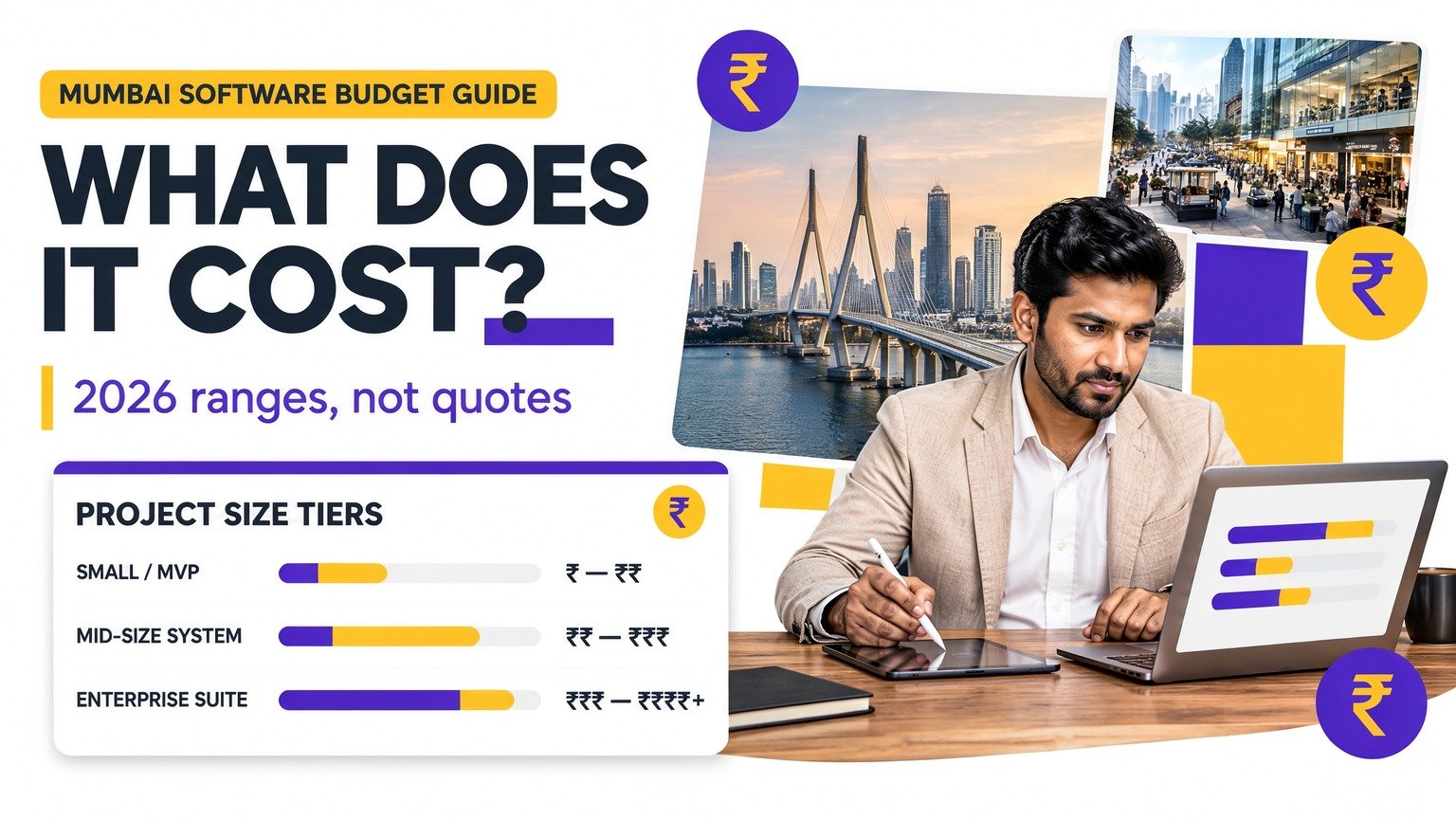
Costs vary so widely by scope that a single number would be a lie. Published market ranges for custom software in Mumbai, gathered from competing agencies’ published price pages:
Startup MVP. Roughly Rs 2.5–4.5 lakh at the lower end of published ranges, up to roughly Rs 8–30 lakh for a more complex platform with multiple user roles and integrations. The range is wide because “MVP” can mean a simple internal tool or a customer-facing app with payments.
Custom CRM or ERP. Roughly Rs 2–12 lakh, depending on the number of modules, users and integrations. A single-department CRM sits at the lower end; a multi-branch system with stock, billing and reporting sits at the higher end.
Custom web app or portal. Roughly Rs 6–15 lakh for a customer portal, booking system or dashboard with logins, payments and reporting.
Hourly rates. Roughly US$15–40 per hour for development teams publishing hourly rates, which works out to roughly Rs 1,250–3,300 per hour at current exchange rates.
GST. 18% GST is usually charged on top of agency quotes, so budget for it.
What pushes the price up. Integrations with payment gateways and WhatsApp, multi-branch permissions, data migration from old systems, and mobile apps alongside the web version.
What pushes the price down. A tight scope, an MVP first, and reusing your existing tools instead of rebuilding them.
Ranges, not quotes.
How long does it take?
Simple internal tool. Roughly 6–10 weeks: one department, a handful of screens, no payment gateway.
MVP with customer-facing features. Roughly 10–16 weeks: logins, payments, notifications, and a mobile-friendly design.
Full platform or multi-module system. Roughly 16–24 weeks or more, usually delivered in stages so parts of it go live earlier.
Who owns the code, and what happens after launch
Two questions to settle before you pay the first invoice, because they are expensive to fix later.
Ownership. You should own the source code, the database and all the data, and you should receive a copy at handover, along with the credentials for the server and the domain. Keep the contract clause that says so. If your developer hosts the system on their own server and will not hand over the code, you are renting, not buying — and you need to know that before you sign.
After launch. Software needs maintenance: security updates, small fixes, and changes as your business changes. Budget roughly 15–20% of the build cost per year for support and small improvements. Ask what the monthly support covers, how changes are priced, and what happens if you want to move to another developer one day — the honest answer is “we hand over the code and the documentation.”
For security, it is worth knowing the basics yourself: the OWASP Top 10 lists the most common web application security risks, and the NIST Cybersecurity Framework sets out how organisations manage that risk. A developer who cannot explain how they handle the OWASP Top 10 is not ready to hold your customer data.
Red flags and mistakes to avoid
A quote with no scope document. A price without a written list of what will be built is a price that will grow. The cheapest quote is usually the one with the vaguest scope.
No handover clause. If the contract does not say you own the code and get a copy, assume you do not.
Everything in version one. A developer who agrees to build every feature anyone mentioned, in one go, is building a project that will run late and launch half-tested. Start with the core, launch it, then add.
No one from your team assigned to the project. Custom software fails when the developer builds it alone and hands it over at the end. Assign one person from your side who knows the daily work, attends the weekly review, and tests each piece as it arrives.
Ignoring the phone. If your staff and customers are on phones and the system is only tested on a desktop, the launch will be the first time anyone sees the problem.
Forgetting training and data migration. Moving your old data — customers, stock, pending orders — takes real time, and your team needs a training session before launch day, not after. Both should be in the quote, not discovered in the last week.
How Digital Dhatu works
Digital Dhatu builds custom software the same way it builds everything else: Understand, then Strategize, then Build, then Launch, then Optimize. First, a scoping session with your team to map how work happens and where the ready-made tools break down. Then a written scope and a fixed quote. Then the build in pieces, with working software to review every few weeks. Then launch alongside the old way of working, with training for your team.
The same team also builds your website, runs your marketing and automates the repetitive work around the software — so the system, the automation and the customer messages all connect. Digital Dhatu’s own products show the same approach in practice: Medofile for clinic and patient records, Servexa for service businesses, and BILLit for billing — Useful reading before you decide: IT Solutions Company in Mumbai and Website Development Cost in Mumbai 2026.
Frequently asked questions
How much does custom software cost in Mumbai?
Published market ranges: a startup MVP roughly Rs 2.5–4.5 lakh at the lower end and up to roughly Rs 8–30 lakh for a complex platform, a custom CRM or ERP roughly Rs 2–12 lakh, and a custom web app or portal roughly Rs 6–15 lakh. Hourly rates run roughly US$15–40 per hour. GST at 18% is usually on top. Ranges, not quotes.
Build or buy — which is right for my business?
Buy when your process is standard and a ready-made tool covers 90 percent of what you need. Build when your process is your advantage, when your team pays a daily workaround tax re-entering data between tools, or when you need your billing, WhatsApp, website and stock to share one customer record.
How long does custom software take?
A simple internal tool takes roughly 6–10 weeks, an MVP with customer-facing features roughly 10–16 weeks, and a full multi-module platform roughly 16–24 weeks or more, usually delivered in stages. The biggest cause of delay is slow decisions on your side, so name one decision-maker before the project starts.
What should a fixed quote include?
The written scope (features, screens, user roles, what counts as finished), the delivery dates for each stage, the testing and training plan, data migration, the support period after launch, and the handover — source code, database and credentials.
Who owns the code and data?
You should, and the contract should say so in plain words: you own the source code, the database and the data, and you receive a full copy at handover. If the developer will not put that in writing, do not sign.
What happens after launch — support and maintenance?
Budget roughly 15–20% of the build cost per year for security updates, small fixes and improvements. Your support agreement should state response times for faults, what is included, and how new features are priced. Launch is the start of the system, not the end of it.
Final word
Custom software is not about having something no one else has. It is about having a system that fits the way your business actually works — one customer record, no re-typing, no notebook on the side. The right question is not “can we afford to build it” but “what is the workaround costing us every month?”
If the workaround is costing you hours a week, talk to a developer who scopes it properly, quotes it in writing, and hands over the code. Book a free consultation with Digital Dhatu: call +91 80800 99200, or visit the contact page. Our offices are in Vashi and Andheri West, Mumbai.
Share:
Want results like these for your business?
Talk to our team for a free consultation, with no obligation.
Start with the free foundations: a complete Google Business Profile with real photos and correct hours, a WhatsApp catalogue of your stock, and 3 to 5…
A basic AMC covers repairs when things break, while managed IT support prevents most breaks in the first place: monitoring, patching, backup checks and a helpdesk…
Short answer: Start with the four apps that matter: Google Business Profile, Zomato, Swiggy, and Instagram. A single-outlet cafe spends around Rs 35,000 to 80,000 a…