Digital Marketing for Restaurants and Cafes in Mumbai: Zomato, Swiggy, Reels and Getting Tables Full
By Ayush DubeyNovember 21, 202614 min read
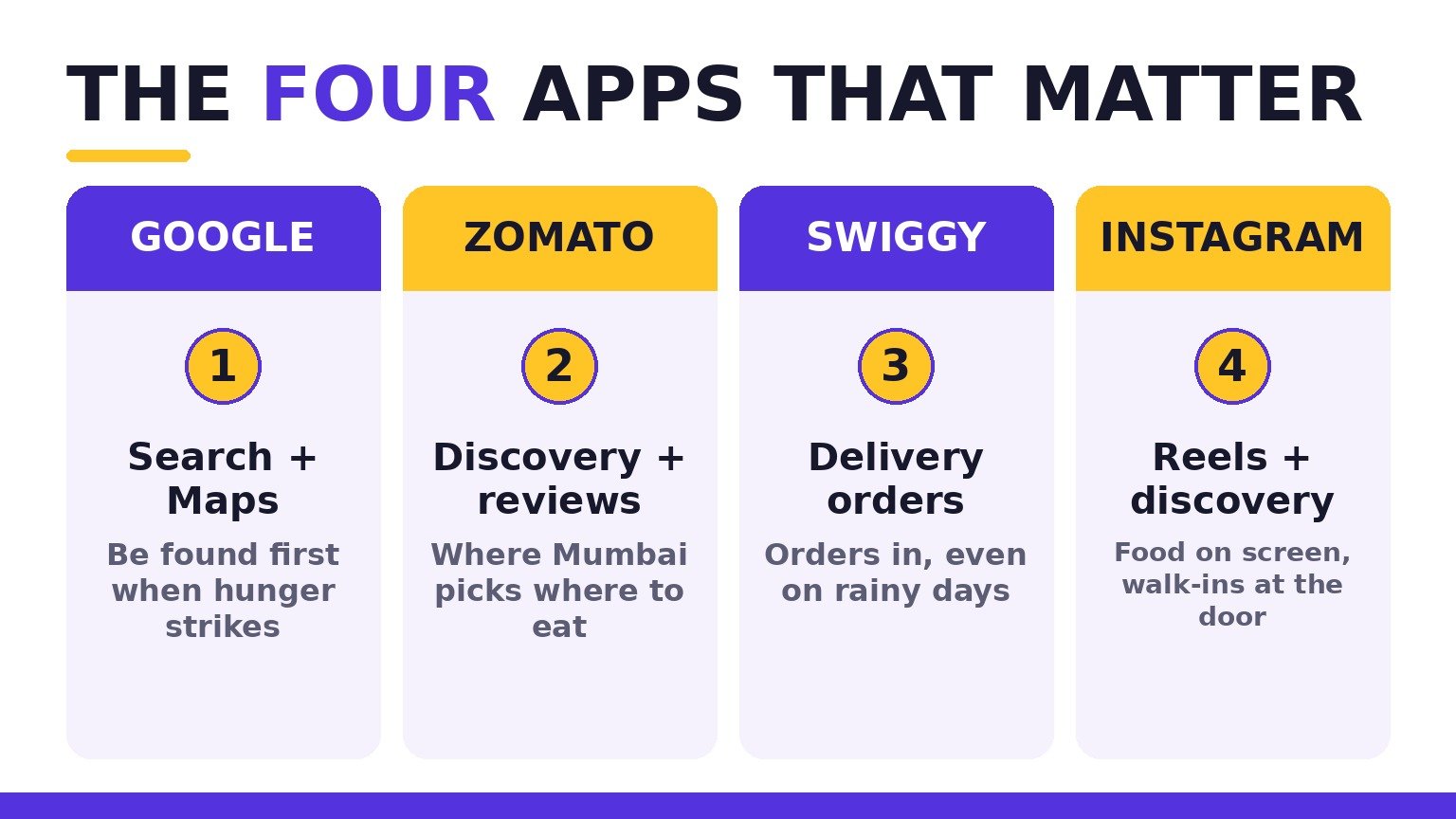
Short answer: Start with the four apps that matter: Google Business Profile, Zomato, Swiggy, and Instagram. A single-outlet cafe spends around Rs 35,000 to 80,000 a month. The trap is commission: aggregators take 15 to 35 percent of every order, so build a direct WhatsApp or website ordering channel alongside them.
On a Friday night in Bandra, a family of four stands outside a small cafe, comparing two places on the same food street. One has 4.6 stars, fresh photos, and a menu updated last week. The other has a blurry photo from two years ago and three unanswered reviews. They walk into the first one. That is what digital marketing for restaurants in Mumbai does: it decides which door a hungry customer walks through, before they ever taste your food.
What does digital marketing for restaurants in Mumbai actually cover?
Digital marketing for restaurants in Mumbai is the system that gets a restaurant found, chosen, and remembered, in a city where most customers decide where to eat on a phone. Four channels working together, plus a way for regulars to order direct.
Google catches the 7 pm search for food near them. Zomato catches the Sunday afternoon browse through ratings. Swiggy catches the dinner-in-40-minutes order. Instagram catches the midnight scroll that decides tomorrow’s lunch by a photo.
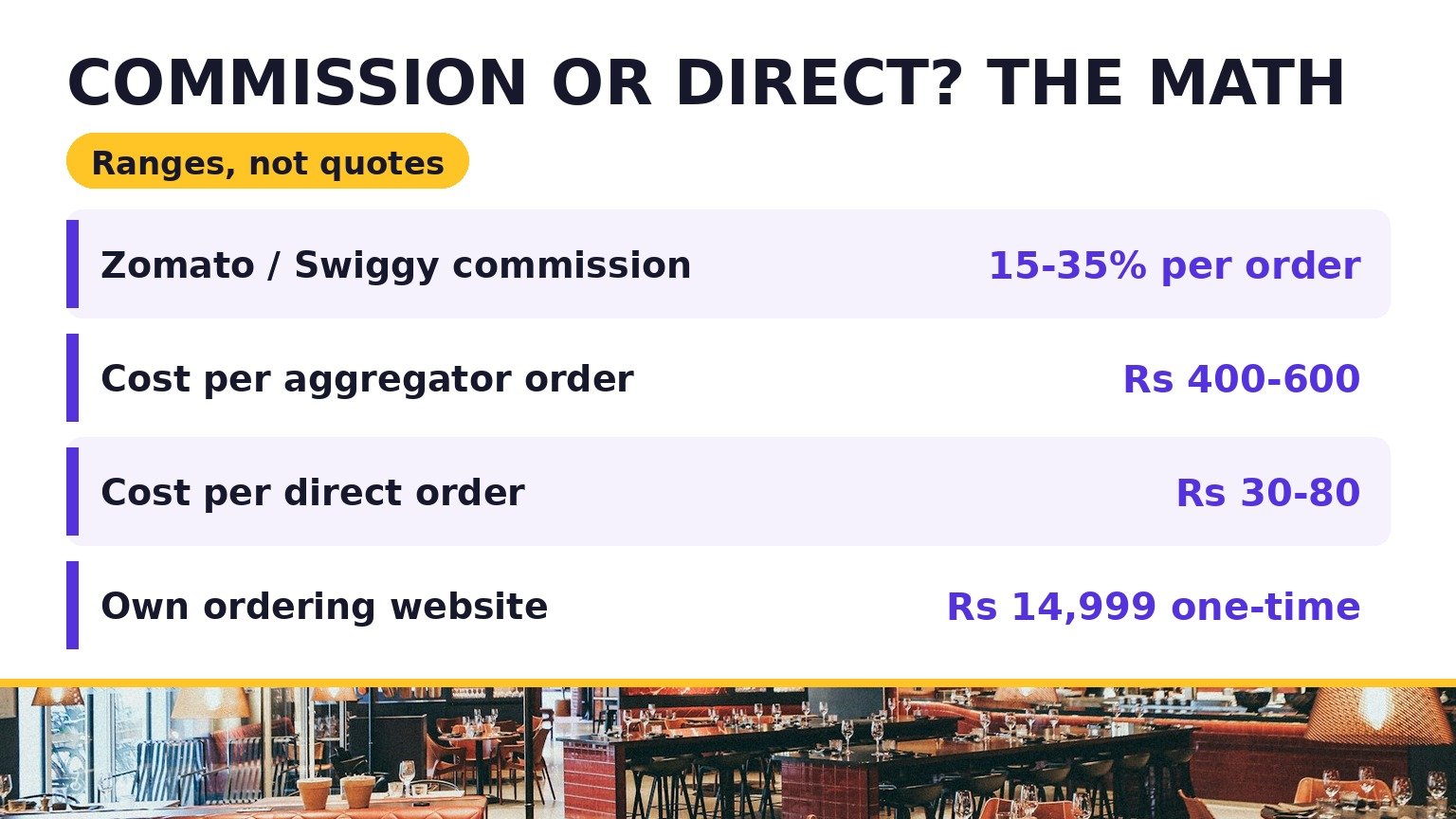
Underneath sits the piece most restaurants skip: your own channel, a WhatsApp ordering list and a simple ordering page on your own website. Without it, every order costs 15 to 35 percent in commission. With it, the same customer costs roughly Rs 30 to 80 instead of Rs 400 to 600.
The four apps that matter
Google Business Profile: your second storefront
Google Business Profile is the free listing that decides whether you appear when someone searches for food near them. Most owners set it up once and never touch it again. Fill in every field, add fresh photos weekly, and post festival menus as updates. A complete profile puts you in the map results within your 3 to 5 km catchment, where almost all walk-in customers come from.
Zomato: discovery and ratings
Zomato is where Mumbai diners compare restaurants before they choose, and your listing is judged in seconds. Good food photography is non-negotiable. Keep the menu current, including prices. Update festival menus the day you launch them; changes take two to three days to show up. Fresh photos and review replies keep the listing alive in the rankings.
Swiggy: delivery
Swiggy is the delivery engine. Most delivery orders come through it, especially in the monsoon, when Mumbaikars would rather order in than wade through a flooded lane. Every dish needs a photo, honest prep times, and packaging that survives a 30-minute ride in the rain. Swiggy ads can buy a top slot in the app. Set a weekly cap on ad credits.
Instagram: visual discovery
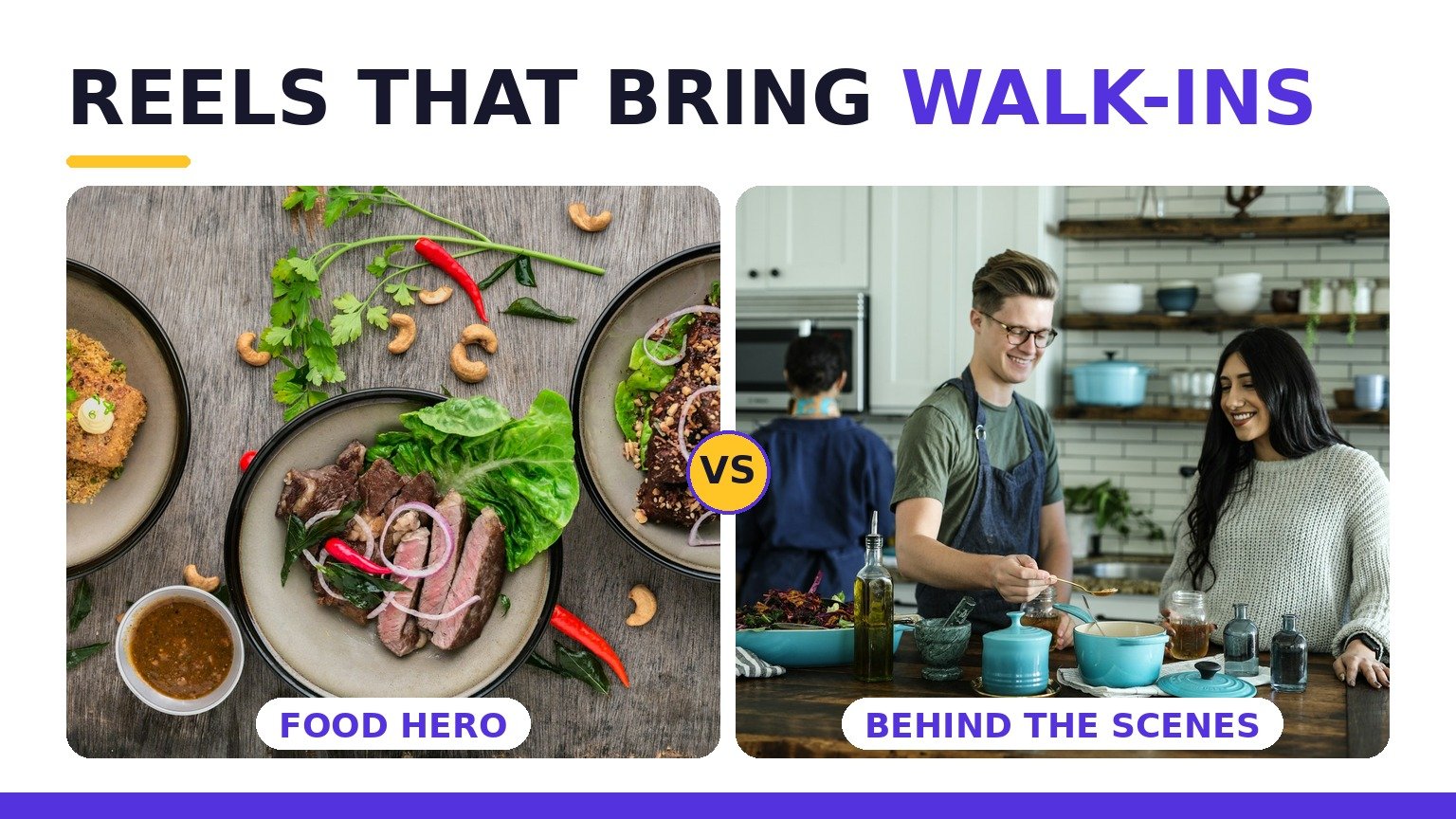
Instagram is where diners under 35 discover restaurants in Mumbai, and they judge yours by the last nine posts on your grid. A grid of real dishes, the kitchen at work, and customers at your tables beats a grid of flyers. Post 3 to 5 Reels a week: a hero dish, a behind-the-kitchen clip, a customer repost, a staff spotlight. Use location tags and hyperlocal hashtags for your neighbourhood. See our guide to social media marketing in Mumbai.
Digital marketing for restaurants in Mumbai by business type
The system is the same, but the emphasis changes with the business.
Dine-in restaurant: Google Business Profile and Zomato matter most.
Cafe: Instagram is your shopfront. A cafe lives on Reels and on being the place people photograph. Keep the grid fresh and the menu short enough to shoot well.
Cloud kitchen: Swiggy and Zomato are your only storefront, so listing quality is everything. Spend on food photography first, then aggregator ads, then a WhatsApp list for direct repeat orders. See our guide to video marketing in Mumbai.
Multi-outlet chain (3 to 10 outlets): The job is consistency: one playbook, one photo standard, one review-reply system, plus a central WhatsApp list and a loyalty offer that works everywhere.
Zomato or Swiggy: which should I spend on first?
If you are a dine-in restaurant or cafe, start with Zomato. Discovery and ratings fill your tables. Spend on fresh photos and a complete menu before you spend on ads.
If you are a cloud kitchen or a delivery-first brand, start with Swiggy. But set a hard rule from day one: every delivery order is a chance to win the next order direct. Put a card in every delivery bag with your WhatsApp number and a small reason to use it next time.
If you run both, split the budget by the revenue you want. Do not pay for ads on a listing that is not ready: ads send people to blurry photos and an outdated menu. Fix the listing first, then buy the traffic.
The commission trap: what an order really costs you
Aggregators bring orders, but they take 15 to 35 percent of every order in commission, plus GST and the discounts you fund to stay visible. CodingClave’s published 2026 guide puts the effective cost per order at roughly Rs 400 to 600 on Zomato and roughly Rs 400 to 500 on Swiggy. A direct order costs roughly Rs 30 to 80.
A restaurant doing Rs 5 lakh a month through aggregators at 25 percent commission pays Rs 1.25 lakh a month. Moving a fifth of those orders direct saves roughly Rs 25,000 a month.
You do not leave the aggregators: they are where new customers find you. Use them for discovery and move repeat customers to your own channel, where the margin is yours. Three moves make it work: collect numbers with consent, send one useful WhatsApp message a week, and make direct ordering easy with a menu catalogue, UPI payment, and a clear delivery time.
Reels that bring walk-ins, not just views
A Reel with 50,000 views and no walk-ins is a failed Reel. A Reel with 800 views and twelve people walking in asking for the dish is a success. Judge Reels by walk-ins and orders, not by views.
The food hero. One dish, close up, steam rising. A 20-second plating video beats a polished brand film.
The making of a dish. The chef at work, the dosa being spread, the coffee being poured. Keep it under 30 seconds.
The place. Your dining room at 7 pm, full and warm.
The people. Your staff, your regulars, a customer tasting the new dish. Ask permission and keep it short.
Post 3 to 5 Reels a week, shot in one session. If you are paying creators, read our guide to influencer marketing in Mumbai first.
Do Google reviews matter for a restaurant?
Yes, more than for almost any other local business. A bad meal wastes an evening and a few hundred rupees, so customers read reviews and replies before they choose.
Ask every customer for a review, not only the happy ones: a QR code on the table, a WhatsApp message after the meal, or a line from the staff at billing.
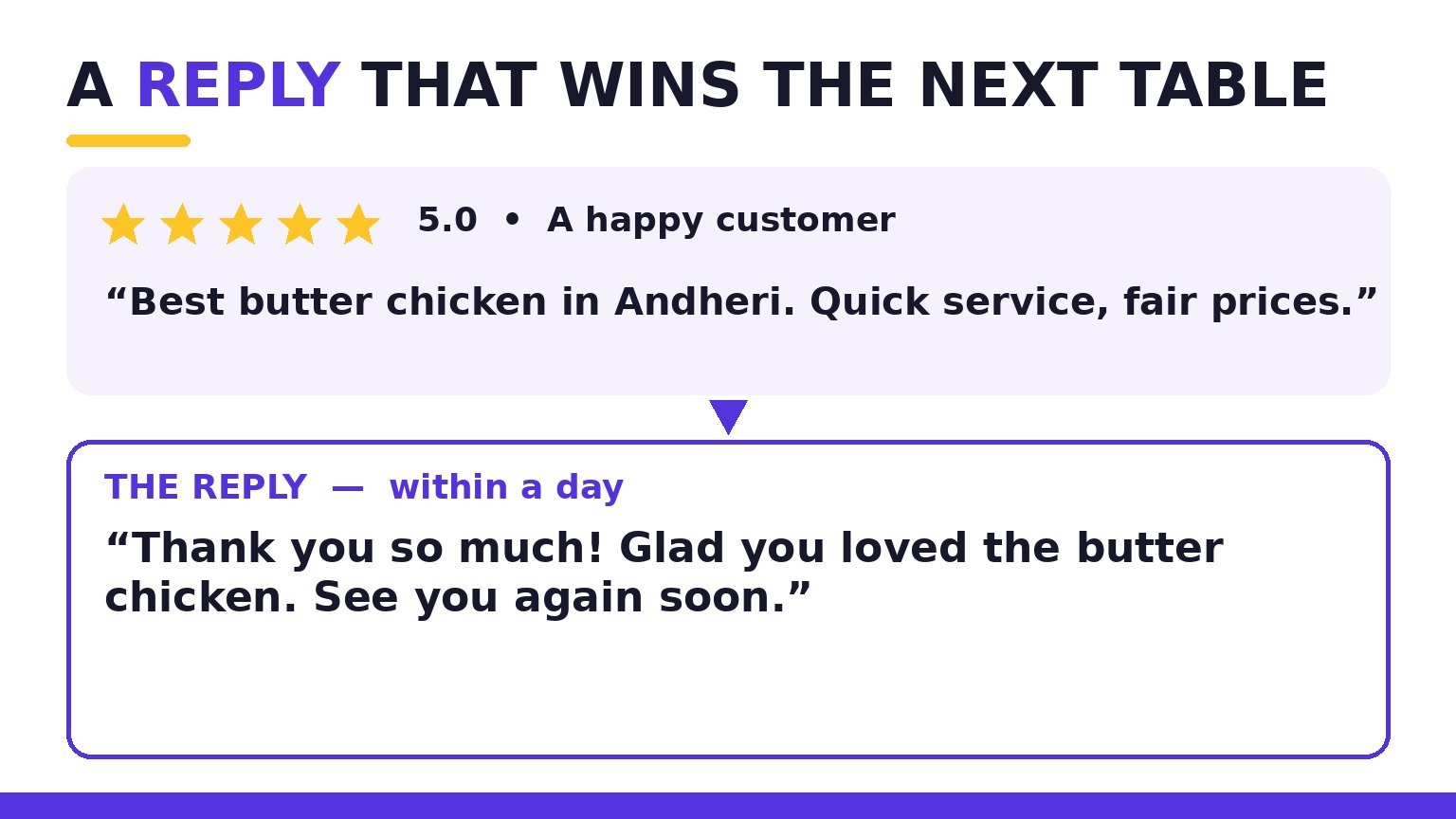
Reply to every review within a day or two. Thank happy customers by name and mention the dish they liked. For a bad review, apologise and move the conversation offline. Never argue in public, never offer a discount or gift for a review, and never buy reviews: platforms remove incentivised reviews, and fake reviews break Indian consumer law. A fake review is reported through the Business Profile. Genuine reviews also help your ranking on Google Maps.
Mumbai specifics: catchment, monsoon, and festival menus
Mumbai is a hundred neighbourhoods, and a restaurant’s customers mostly live and work within 3 to 5 km of it. Market as locally as your catchment: location tags and listings that name your area, Bandra West, Andheri, Borivali, or Vashi.
The food streets matter too: Bandra’s Carter Road and Pali Hill, Andheri’s Lokhandwala and Veera Desai Road, Borivali’s food lanes. People go there to eat, browsing their phones as they walk, and a strong listing and a fresh Zomato rating decide which door they enter.
The monsoon changes the business every year: delivery orders rise, walk-ins dip, and delivery times stretch. Keep your Swiggy prep times honest during July and August, and use the rainy weeks to shoot Reels and update listings. Festivals are the other Mumbai rhythm: Diwali, Eid, Ganesh Chaturthi, Christmas, and the wedding season each bring a different crowd and menu. A short festival menu, launched with a Reel and updated on Zomato and Google the same day, brings a spike of orders a generic offer never will.
What to ask before you sign
Ask these five before you pay anyone.
Who owns the photos and videos? Insist you own the photos, the raw footage, and the final files.
How is success measured? If the vendor talks about views and followers, they are selling content, not marketing. Agree on walk-ins per Reel and cost per order.
What happens to my Zomato and Swiggy listings? Who updates the menu, the photos, and the prices, and how fast?
How will you build my direct channel? If the plan is only aggregator ads and Instagram posts, the commission trap stays open.
What does the monthly report show? You should see orders and walk-ins by channel, cost per order by channel, and review counts, every month. If the report only shows reach and likes, you cannot tell whether the money worked. See our guide to business automation in Mumbai.
What does digital marketing cost for a restaurant in Mumbai?
All costs below are published market ranges. Ranges, not quotes.
What you are buying
Published market range
Single-outlet cafe, all-in monthly
~Rs 35,000-80,000/month
Cloud kitchen / multi-cuisine delivery brand
~Rs 1,00,000-3,00,000/month
Multi-outlet chain (3-10 outlets)
~Rs 3,00,000-10,00,000/month
Restaurant social retainer, starter (8 Reels, 1 shoot day)
~Rs 18,000-25,000/month
Restaurant social retainer, standard (12 Reels, 2 shoot days)
~Rs 25,000-40,000/month
Zomato/Swiggy ad-management retainer
~Rs 15,000-75,000/month
Own zero-commission ordering website (one-time)
~Rs 14,999 one-time
Paid ads
From ~Rs 200/day
The all-in and cost-per-order ranges come from CodingClave’s 2026 restaurant guide, the social retainers from HireSocials (Nov 2026), the ad-management and ordering-website ranges from LeadSutra and Elixir Digitals, and the paid-ads starting point from Chuk.in’s 2026 playbook.
The cost-per-order comparison is the number to remember: Zomato roughly Rs 400 to 600 an order, Swiggy roughly Rs 400 to 500, and a direct order roughly Rs 30 to 80. Start with the free foundations: a complete Google Business Profile, fresh photos and menu, and 3 to 5 Reels a week shot on a phone.
What breaks: the mistakes that fill the wrong tables
Paying for ads on a broken listing. Fix the listing first, then buy the traffic.
Funding discounts you cannot afford. Discounts should buy a first order from a new customer, not subsidise every order forever.
Posting food photos and nothing else. A grid of dishes with no people and no place is a menu, not a brand.
Ignoring reviews. An unanswered one-star review sits at the top of your listing and answers every future customer for you.
No direct channel. A restaurant with no WhatsApp list and no ordering page pays 15 to 35 percent on every order, forever.
The 8-point weekly checklist
Run through this list every Monday.
Google Business Profile updated: one new photo and one post this week.
Zomato and Swiggy menus checked: prices and dishes current.
Three to five Reels posted: one food hero, one behind-the-kitchen clip.
Every review replied to: Google, Zomato, and Swiggy, within two days.
WhatsApp list grown: new numbers collected with consent.
One useful WhatsApp message sent: the new dish or the festival offer.
Ad spend checked: aggregator ad credits and discount funding within the weekly cap.
Numbers reviewed: walk-ins, orders, and cost per order by channel.
How do you know it is working?
Measure five numbers weekly, per channel:
Walk-ins per Reel: people who mention a Reel when they arrive.
Orders per channel: Zomato, Swiggy, WhatsApp, and website, counted separately.
Cost per order by channel: channel spend divided by channel orders, including commission.
Review growth: new genuine reviews per week and your average rating.
Repeat rate: first-time customers who order again within 30 days.
The first walk-ins from Reels usually arrive in 2 to 4 weeks of posting 3 to 5 a week. A steady pipeline of direct orders takes 8 to 12 weeks. If the numbers do not move in 8 weeks, the problem is usually the listing, the offer, or the tracking.
Frequently asked questions
How much does digital marketing cost for a restaurant in Mumbai?
A single-outlet cafe runs around Rs 35,000 to 80,000 a month, a cloud kitchen around Rs 1,00,000 to 3,00,000 a month, and a chain around Rs 3,00,000 to 10,00,000 a month. A starter retainer is around Rs 18,000 to 25,000 a month; paid ads start at around Rs 200 a day. Ranges, not quotes; 18% GST applies.
Zomato or Swiggy, which should I spend on first?
For a dine-in restaurant or cafe, start with Zomato: discovery and ratings fill your tables. For a cloud kitchen, start with Swiggy: delivery is your whole business. Fix the listing with fresh photos and a current menu before you spend on ads, and build a direct WhatsApp ordering channel alongside.
How do I reduce the commission I pay on every order?
Use the aggregators for discovery, then move repeat customers to your own channel. Collect numbers with consent, send a weekly WhatsApp message, and make direct ordering easy. A direct order costs roughly Rs 30 to 80, against roughly Rs 400 to 600 on Zomato and Rs 400 to 500 on Swiggy.
How many Reels should a cafe post a week?
Aim for 3 to 5 Reels a week: a food hero, a behind-the-kitchen clip, a customer repost, or a staff spotlight. Shoot them in one session a week.
Do Google reviews matter for a restaurant?
Yes, more than for almost any other local business. Customers read reviews before choosing where to eat, and genuine reviews help your ranking on Google Maps. Ask every customer with a QR code or a WhatsApp message, and never buy reviews or offer a gift for one.
Should I hire an agency or do it in-house?
Do it in-house if the owner or one staff member can give the system 30 to 45 minutes a day and someone is comfortable shooting Reels on a phone. Hire a freelancer for editing and posting, from around Rs 18,000 to 25,000 a month. Hire an agency if you run multiple outlets.
Talk to Digital Dhatu before your next festival menu
The most expensive table is the empty one on a Friday night.
Digital Dhatu helps Mumbai restaurants, cafes, cloud kitchens, and chains get found on Google, Zomato, Swiggy, and Instagram, and build the direct ordering channel that keeps the margin at home. We work from our offices in Vashi and Andheri West.
Book a free consultation and bring your last month of aggregator bills, or just your phone. Contact Digital Dhatu today.
Share:
Want results like these for your business?
Talk to our team for a free consultation, with no obligation.
Start with the free foundations: a complete Google Business Profile with real photos and correct hours, a WhatsApp catalogue of your stock, and 3 to 5…
A basic AMC covers repairs when things break, while managed IT support prevents most breaks in the first place: monitoring, patching, backup checks and a helpdesk…