Digital Marketing for Real Estate in Mumbai: Turn Leads Into Site Visits, Not Just Enquiries
By Ayush DubeyNovember 14, 202613 min read
Short answer: The point of property marketing is not the number of enquiries — it is the number of people who walk into your site office. A good Mumbai campaign connects Google ads, Meta ads, a project landing page, WhatsApp follow-up and one lead record — judged on cost per site visit, not cost per lead. Google search leads run roughly Rs 800 to Rs 3,000 each in tier-1 cities; Meta leads roughly Rs 150 to Rs 800 for affordable and mid-segment homes. Ranges, not quotes.
The enquiry that never became a site visit
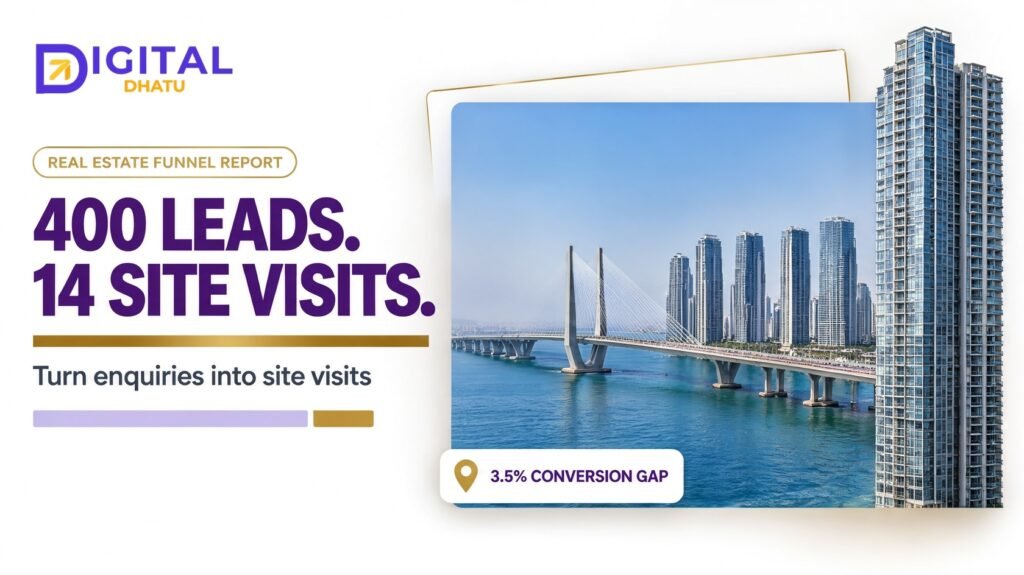
A developer in Thane spends Rs 2 lakh a month on ads and gets 400 enquiries. The sales team calls them all, and 14 people turn up for a site visit. That is a 3.5% conversion from enquiry to visit — and the real story of digital marketing for real estate in Mumbai is written in that gap, not in the 400. The leads were called back slowly and shown a generic page instead of the flat they asked about. By the time someone rang, they had visited a competitor’s site.
A 1BHK in Andheri West and a 3BHK in Powai are different products, budgets and buyers — one campaign cannot treat them the same.
What digital marketing for real estate in Mumbai actually means
It is the journey from the first ad to the site-office visit. Five parts, working together.
1. Being found when a buyer searches. A buyer types “2BHK in Andheri West under 2 crore” into Google. Your project should appear, with a landing page answering that exact search: price range, configuration, location, possession date. Not your homepage.
2. Being seen where a buyer scrolls. A buyer who has looked at property sites sees your video or carousel ad on Facebook and Instagram — the right project, the right budget bracket, the right micro-market, before the buyer has decided.
3. A landing page built for one project. One page, one project, one action: book a site visit. Price range, floor plan, location map, RERA number, and a form asking for name, number and preferred visit time. Nothing more.
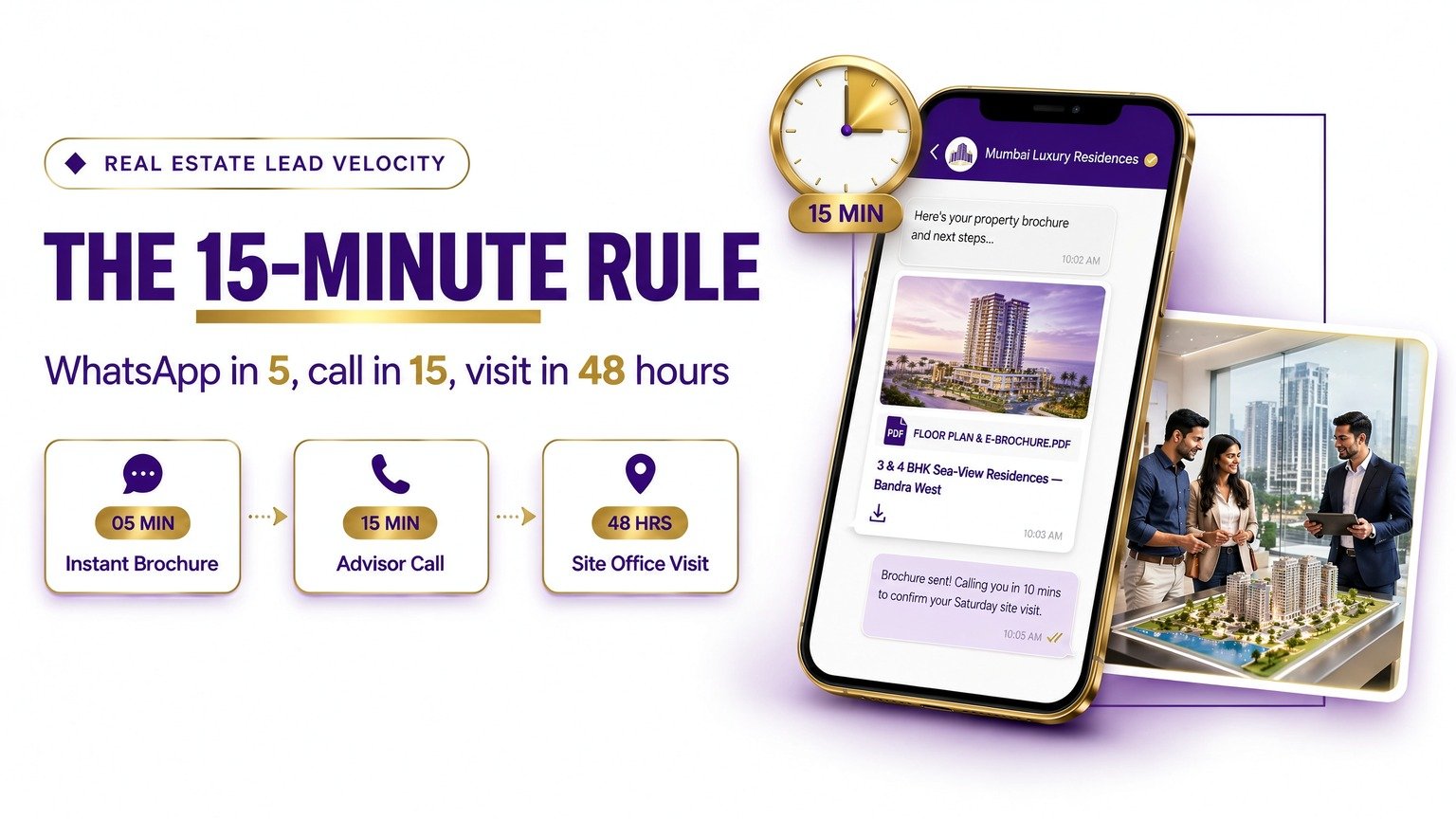
4. Follow-up in minutes, not days. An enquiry called back in 15 minutes is far more likely to become a visit than one called back the next day. In Mumbai this happens on WhatsApp: brochure, location pin and visit reminder, in the chat the buyer already uses.
5. One lead record, from ad to booking. Every enquiry lands in one system, with a source, a budget, a location preference and a next step. Without it, the same lead gets called by two people, or by nobody.
Miss one of the five and the others leak.
The only number that matters: cost per site visit
Ask any agency for their cost per lead and they will give you a number that sounds good. Ask for their cost per site visit and you will learn whether the campaign works.
A portal lead costs little, but only about 3 to 5 out of every 100 portal leads turn into a site visit, per published industry figures. So 100 portal leads at Rs 300 each cost Rs 30,000 and produce roughly 3 to 5 visits — about Rs 6,000 to Rs 10,000 per visit. A portal lead is also a shared lead: the same buyer has enquired on five projects, and the portal sells that enquiry to all five.
A project landing-page funnel, by contrast, is claimed by some competitors to convert 12 to 18 out of every 100 leads into visits. Those are competitor claims, not Digital Dhatu results — ask any agency making them to show the workings. A lead who chose your project page is worth far more than a lead who ticked a box on a portal.
Work it backwards from your target. If you need 40 site visits a month and your funnel converts 10% of leads into visits, you need 400 leads. At Rs 500 a lead, that is Rs 2 lakh a month in media. At 5%, you need 800 leads and Rs 4 lakh for the same 40 visits. The funnel is the budget: spend on the landing page and the follow-up before you spend on more ads.
Google or Meta: where each rupee works
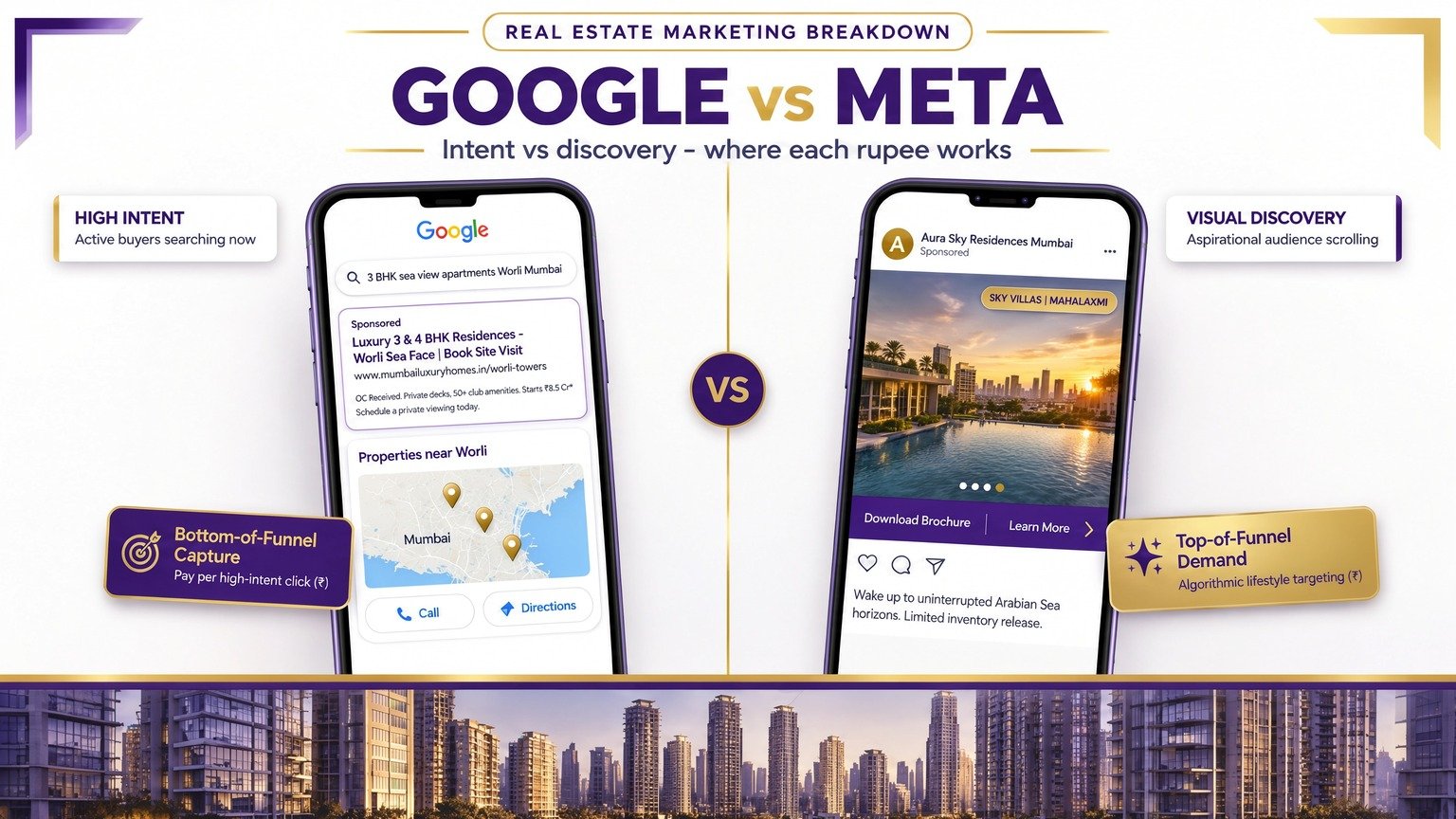
Google and Meta do different jobs; a Mumbai project usually needs both.
Google Search catches buyers who have already decided to look. Someone searching “3BHK Powai ready to move” is close to a visit. That intent is why Google leads cost more: published market ranges put Google search leads for real estate in tier-1 cities at roughly Rs 800 to Rs 3,000 each, and for luxury homes above Rs 1.5 crore at roughly Rs 2,000 to Rs 6,000 each. Use Google for ready inventory and for your own project and builder name — if you do not bid on your own name, a competitor or a portal will.
Meta finds buyers before they search. A carousel of your 2BHK in Andheri, shown to people aged 28 to 45 who have recently looked at property sites and live within a realistic commute, creates the enquiry that Google later closes. Published market ranges put Meta leads at roughly Rs 150 to Rs 800 each for affordable and mid-segment homes, and roughly Rs 500 to Rs 2,000 each for premium homes. Meta is cheaper per lead and weaker per lead: more enquiries, more wrong numbers, more people who are “just looking”.
The split that works for most Mumbai projects: roughly 60% of media on Google for high-intent searches and 40% on Meta for discovery, then move money toward whichever channel produces the cheaper site visit.
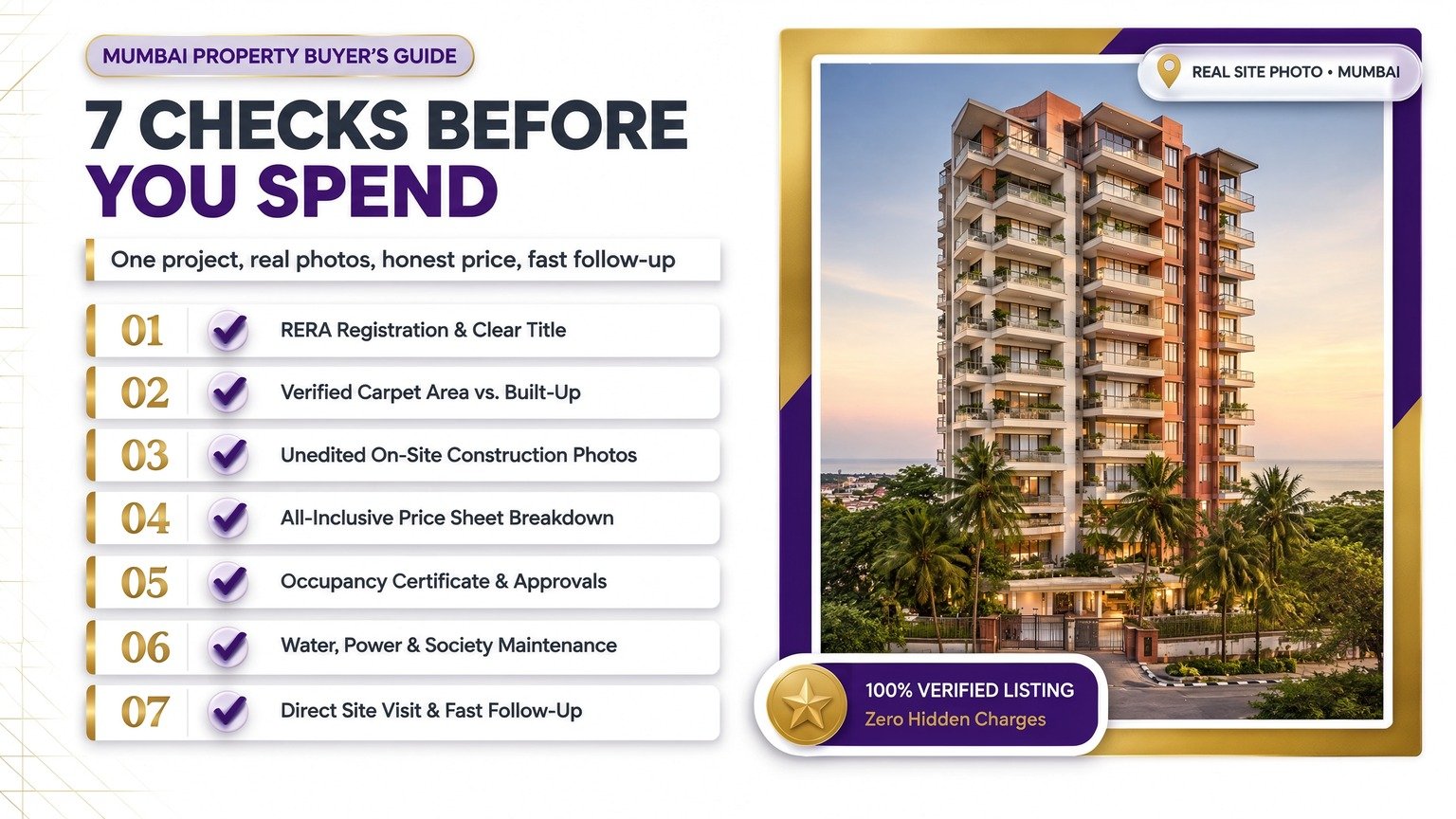
The 7 checks before you spend a rupee on property marketing
1. Is the landing page about one project only?
If your ad for a 2BHK in Malad sends the buyer to your company homepage, you have lost them. One project, one page, one action: book a site visit.
2. Does the creative show the real flat, not a stock photo?
Mumbai buyers have seen the same swimming-pool stock photo a hundred times. A real photo of the actual living room, the actual view and the actual walk to the station builds trust a render cannot.
3. Is the budget bracket honest?
An ad that says “luxury 2BHK” and a landing page that says “starting Rs 2.4 crore” will collect enquiries from people with a Rs 1.2 crore budget. They will never visit. Put the price range in the ad itself.
4. Is the form asking for only what you need?
Name, mobile number, preferred visit day. That is enough. Every extra field costs you enquiries.
5. Is the follow-up timed in minutes?
Check who calls the lead, and how fast. The rule in this guide: a WhatsApp message within 5 minutes, a call within 15 minutes, a visit offered within 48 hours.
6. Is the campaign MahaRERA-compliant?
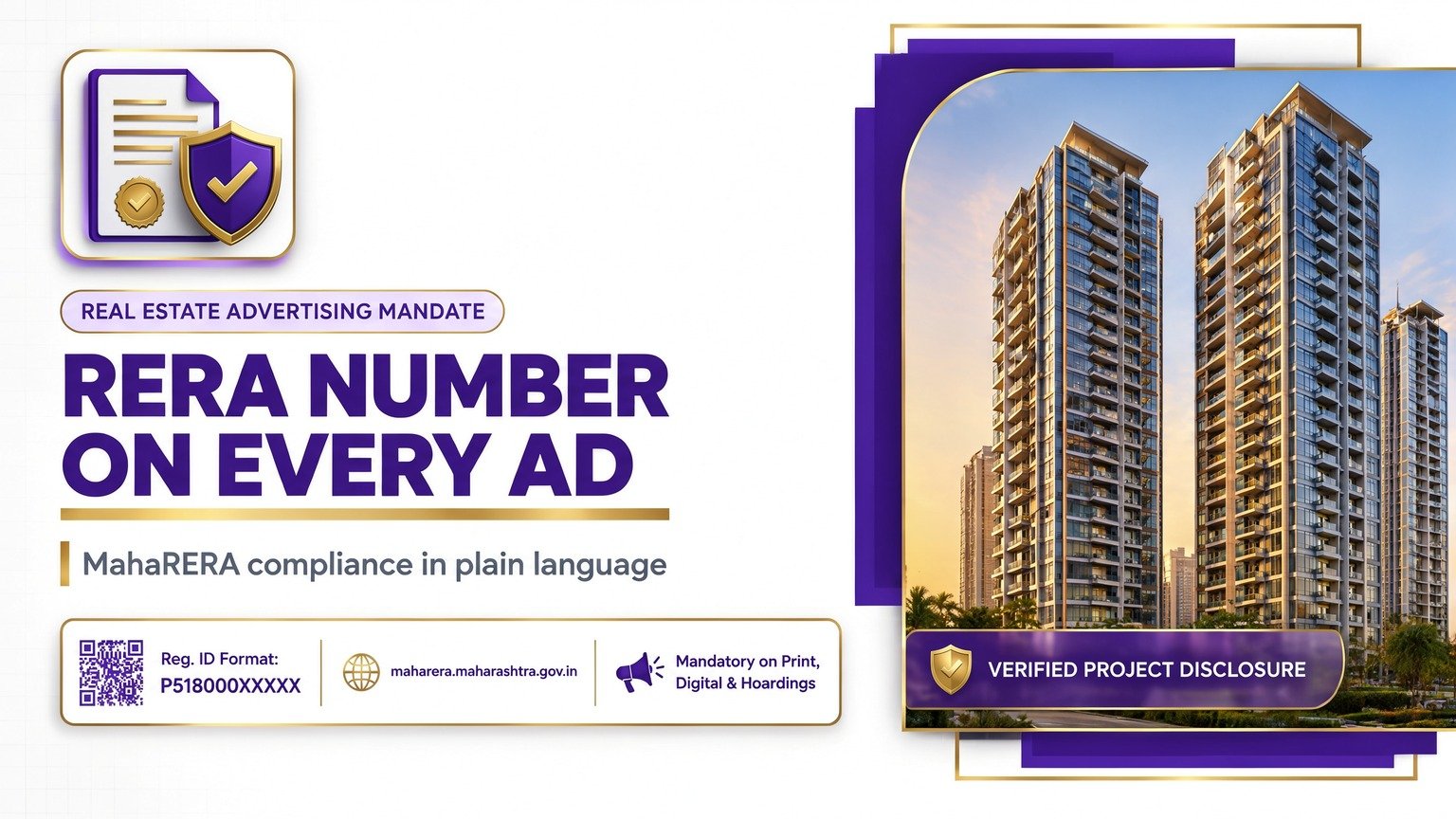
Every ad, landing page and creative for a project in Maharashtra must carry the project’s MahaRERA registration number and the official website address, and the claims in the ad must match the registered details.
7. Can you see cost per visit, not just cost per lead?
Ask to see the weekly report before you sign. If it shows impressions, clicks and leads, but not visits and bookings, the agency is reporting what is easy, not what matters.
MahaRERA compliance in your ads: the plain version
The Maharashtra Real Estate Regulatory Authority — MahaRERA — regulates how projects are advertised in Maharashtra. The practical rules:
Show the registration number. Every advertisement for a registered project must display the MahaRERA registration number and the authority’s website address — on the landing page, in the ad creative where space allows, and in the brochure. A buyer should never have to ask for it.
Advertise only what is registered. The configuration, carpet area, possession date and amenities in your ad must match the details filed with MahaRERA.
Do not promise what the registration does not support. “Assured returns” and “guaranteed appreciation” are the fastest way to a complaint. Describe the project: location, configuration, price range, possession date.
All figures below are published market ranges. Ranges, not quotes.
Channel / item
Published market range
Google Search lead, real estate, tier-1 cities
Roughly Rs 800–3,000 per lead
Google Search lead, luxury (Rs 1.5 Cr+)
Roughly Rs 2,000–6,000 per lead
Meta lead, affordable / mid-segment
Roughly Rs 150–800 per lead
Meta lead, premium segment
Roughly Rs 500–2,000 per lead
Portal lead to site visit
Roughly 3–5% of leads become visits
Project landing-page funnel to site visit
Competitor claims of 12–18% — ask for proof
Agency management fee
Often 10–20% of media spend, or a monthly retainer
A realistic starting budget for a single mid-segment Mumbai project is roughly Rs 1.5 lakh to Rs 3 lakh a month in media, plus the management fee and the landing page build.
The 15-minute rule: follow-up is the campaign
Most property marketing advice stops at the ad. The money is made — or lost — in the hour after the enquiry.
Minute 0–5: the WhatsApp acknowledgement. The buyer gets a message instantly: project name, price range, brochure, and one question — “Would you like to visit this Saturday or Sunday?” Mumbai buyers reply to WhatsApp at midnight; they do not answer unknown numbers.
Minute 5–15: the call. A real person calls, confirms the budget bracket and the location, and offers two specific visit slots. Not “when would you like to come?” — “Saturday 11 AM or Sunday 4 PM?” Specific beats open-ended.
Hour 1: the location pin. The buyer gets the site-office pin, the nearest station, and what to bring.
Day before the visit: the reminder. A WhatsApp message the evening before, and another two hours before the visit. Missed visits are the most expensive leak after slow follow-up, and a reminder costs almost nothing.
After the visit: the same-day follow-up. The buyer leaves the site office and gets a thank-you message, the payment plan and the answers to the questions they asked — the same day, while the flat is still fresh in their mind.
This is where WhatsApp automation earns its fee: the instant reply, the reminder and the after-hours answer all happen without a person sitting awake at midnight.
Micro-markets: one Mumbai, many buyers
“Mumbai” is not one property market. A buyer for Andheri West cares about the metro and the airport. A buyer for Powai cares about schools and the lake. A buyer for Thane cares about the price per square foot and the expressway. A buyer for Navi Mumbai cares about the upcoming airport and the new metro lines.
Andheri West and Versova: mid to premium 2BHK and 3BHK; video walkthroughs work well.
BKC and the Bandra–Kurla belt: premium and luxury, strong Google search intent, the highest lead costs.
Powai and Chandivali: family buyers, schools and green space in the creative; Meta works well here.
Thane and Ghodbunder Road: value buyers, first homes, price per square foot in the ad itself.
Navi Mumbai — Vashi, Nerul, Kharghar: buyers betting on infrastructure; show connectivity — the station, the highway, the airport.
Red flags and mistakes to avoid
Buying bulk leads. A spreadsheet of 10,000 numbers is not an audience. It is a fast way to get reported, blocked on WhatsApp, and to burn the number your buyers already trust.
Hiding the price. “Price on request” does not create curiosity — it creates enquiries from people who cannot afford the project and silence from people who can. Put the range in the ad.
One landing page for five projects. A buyer who clicked on a 2BHK in Malad and lands on a page showing a 3BHK in Borivali will leave.
No RERA number on the creative. The easiest compliance check in this guide and the most commonly skipped.
Reporting leads, not visits. An agency that reports 400 leads and never mentions visits is reporting the number that makes them look good.
Creatives that break Meta’s property-ad rules. Meta has specific rules for housing and property ads, including how audiences can be targeted. Check Meta’s advertising policies before a campaign goes live.
How Digital Dhatu works
Digital Dhatu builds property marketing the same way it builds everything else: Understand, then Strategize, then Build, then Launch, then Optimize. First, the project, the micro-market, the buyer and the budget. Then the plan: channels, micro-markets, landing page, follow-up speed. Then the build: landing page, creatives, WhatsApp flows, single lead record. Launch with one project and one micro-market, check the cost per visit for two weeks, then scale what works.
How much does real-estate marketing cost in Mumbai?
Published market ranges put Google search leads at roughly Rs 800 to Rs 3,000 each in tier-1 cities, and Meta leads at roughly Rs 150 to Rs 800 for affordable and mid-segment homes and Rs 500 to Rs 2,000 for premium homes. Ranges, not quotes.
Google Ads or Meta Ads for property?
Both, for different jobs. Google catches buyers already searching for a location and configuration — higher intent, higher cost per lead. Meta finds buyers before they search, with cheaper leads and more volume, but more people who are only looking.
How many leads become site visits?
Published industry figures put portal leads at roughly 3 to 5 site visits per 100 leads. Project landing-page funnels claim 12 to 18 per 100 — those are competitor claims, so ask any agency making them to show the workings.
What is MahaRERA compliance in ads?
Every ad for a project in Maharashtra must display the project’s MahaRERA registration number and the authority’s website address, and the claims in the ad — configuration, carpet area, possession date, amenities — must match the registered details. Verify any project’s registration on the official MahaRERA website at maharera.maharashtra.gov.in.
How fast should leads be followed up?
Within 15 minutes. Send a WhatsApp acknowledgement within 5 minutes, call within 15 minutes, and offer two specific visit slots within 48 hours. A lead called after two days has usually already visited a competitor’s site.
Do portals replace an agency?
No. Portals are good for discovery — a buyer comparing twenty projects will start there — but a portal lead is shared with every project the buyer enquired about, which is why only about 3 to 5 in 100 become visits. Your own funnel produces leads who chose your project specifically.
Final word
A Mumbai developer does not lose bookings because the project is bad. It loses them in the gap between the enquiry and the site visit — the slow callback, the generic landing page, the missing RERA number, the lead with no owner. Fix that gap first, and the same budget will produce more people at your site office.
Book a free consultation with Digital Dhatu: call +91 80800 99200, or visit the contact page. Offices in Vashi, Navi Mumbai and Andheri West, Mumbai.
Share:
Want results like these for your business?
Talk to our team for a free consultation, with no obligation.
Start with the free foundations: a complete Google Business Profile with real photos and correct hours, a WhatsApp catalogue of your stock, and 3 to 5…
A basic AMC covers repairs when things break, while managed IT support prevents most breaks in the first place: monitoring, patching, backup checks and a helpdesk…
Short answer: Start with the four apps that matter: Google Business Profile, Zomato, Swiggy, and Instagram. A single-outlet cafe spends around Rs 35,000 to 80,000 a…