Business Automation in Mumbai: What to Automate First, and What It Actually Costs
By Ayush DubeyNovember 19, 202613 min read
Short answer: Start with the workflow that loses the most enquiries or cash. For most Mumbai businesses, that is enquiry capture and follow-up, then GST invoicing and payment reminders. A starter setup with one or two core workflows typically costs around Rs 8,000 a month in published market ranges, with first results in 4 to 8 weeks.
Every morning at 9, the phone starts ringing at a dental clinic in Andheri, a real estate office in Thane, and a trading firm in Masjid Bunder, and by 10 the same story repeats: an enquiry that came in on WhatsApp at midnight is still unanswered, an invoice from last week is still unpaid, and someone is copying names from a notebook into a spreadsheet. This is exactly the mess that business automation in Mumbai is meant to fix, not by replacing people, but by taking the repetitive copying, chasing, and reminding off their plates.
What does business automation in Mumbai actually mean?
Business automation means using software to carry out repetitive business tasks without a person doing each step by hand. When a customer fills a form on your website, the details land in your CRM, a WhatsApp message goes out automatically, a reminder is set for your sales person, and an invoice is raised when the deal closes. Nobody retypes anything.
It is not one product. It is a set of connected tools and rules: a CRM to hold customer details, WhatsApp or email tools to send messages, billing software for invoices, and simple rules that connect them, such as “if an enquiry comes from Instagram, assign it to Priya and send the price list within 5 minutes.”
For a Mumbai business, automation has a local flavour. Your customers message on WhatsApp first and call second. They pay by UPI and expect a GST invoice. They expect a reply in minutes, because the competitor two lanes away replies in minutes.
Why most Mumbai businesses automate the wrong thing first
The most common mistake is automating the flashiest task instead of the costliest one. A business buys a chatbot before it has a system to record enquiries. It automates birthday wishes before it automates payment reminders. The result looks modern and changes nothing.
Ask three questions before you automate anything: where do we lose money today, what do we do by hand more than 10 times a week, and what stops when one person is on leave? Start with the workflow that scores highest. That is almost always the enquiry-to-payment journey, not a side task.
The 5 workflows to automate first
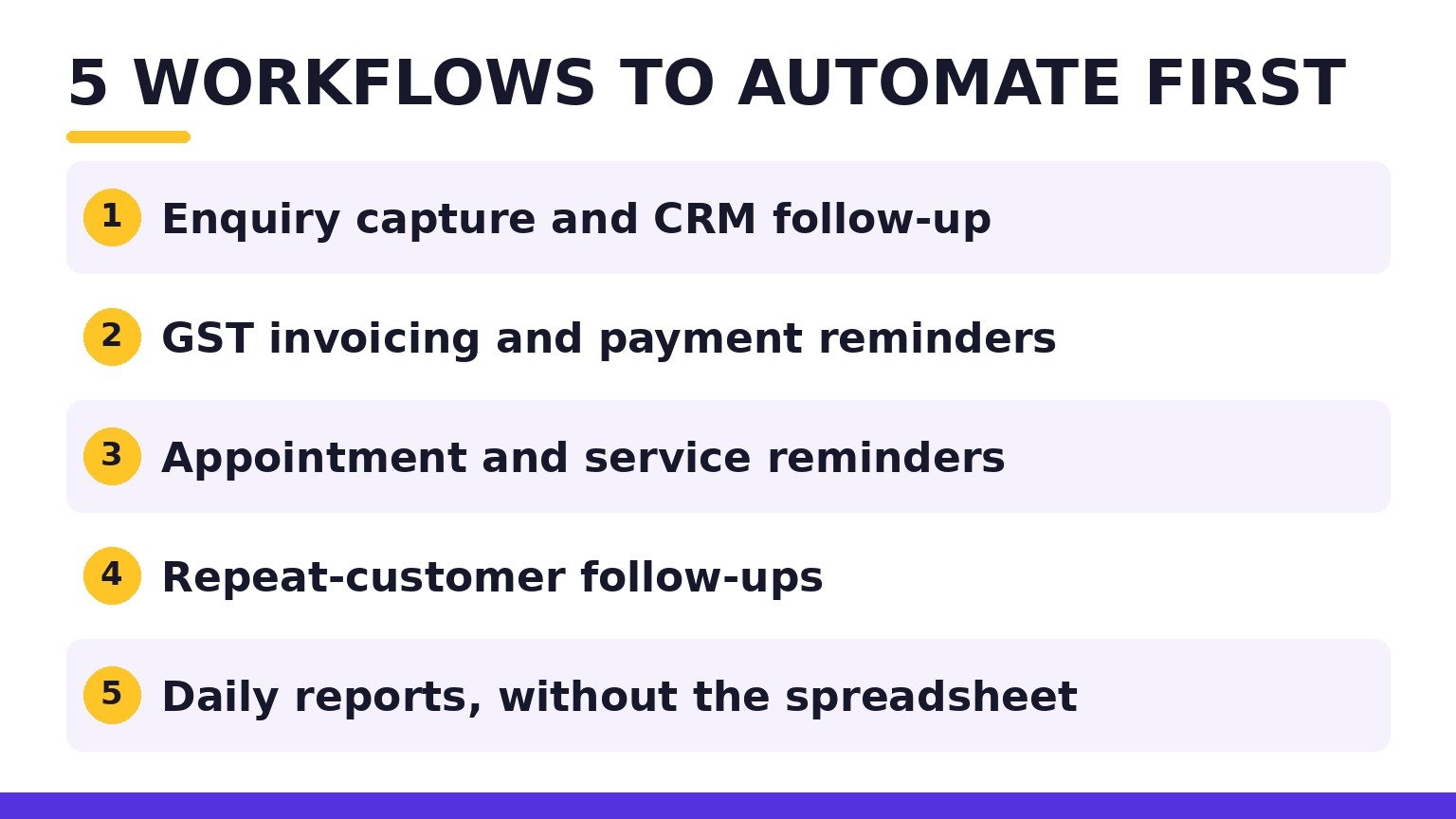
You do not need to automate everything. You need to automate five workflows, in this order, because each one protects revenue or cash.
1. Enquiry capture and follow-up
Every enquiry from your website, Instagram, Google profile, or WhatsApp must land in one place, with the source recorded, and get a reply within minutes, even at 10 pm. An instant acknowledgement with your price list or brochure, followed by a human call the next morning, converts far more enquiries than a reply that arrives two days later. A good CRM for your business is the foundation here, because follow-up only works when every enquiry, call, and promise is recorded in one place.
2. GST invoicing and payment reminders
Raising an invoice should take a minute, not half an hour of formatting and retyping. When a deal closes or a service is delivered, the invoice should be generated from the same customer record, sent on WhatsApp or email, and followed by polite reminders before and after the due date. Businesses that automate reminders get paid faster, because the reminder goes out on time every time.
Keep your billing GST-ready and UPI-friendly. The invoice should carry the GST details, and the payment link or UPI ID should be right there in the message, so paying takes seconds.
3. Appointment and service reminders
No-shows are silent revenue loss. A clinic, salon, coaching class, or service business in Mumbai loses real money every time a booked slot goes empty. Automated reminders, a confirmation message a day before and a short message an hour before, cut no-shows sharply. Add a simple reschedule link and the slot can be offered to the next person on the waiting list instead of sitting empty.
4. Repeat-customer follow-ups
It costs far more to win a new customer than to keep an existing one, yet most businesses never message a past customer until they need something. Automate the follow-ups that matter: a renewal or service-due reminder, a restock message for regular buyers, a festival greeting with a real offer, and a check-in 30 days after a purchase.
The rule is simple: every automated message must be useful to the person receiving it. A reminder that a water purifier service is due is useful. A random promotional blast at 8 in the morning is not.
5. Daily and weekly reports
The owner should not have to ask five people for numbers. A daily message with yesterday’s enquiries, today’s appointments, and pending payments, plus a weekly summary of sales and follow-ups, gives you control without a morning meeting. When the numbers arrive automatically, problems surface early.
What should your business automate first? It depends on your business
There is no single right order. It depends on where you bleed most.
Clinics and salons: Start with appointment reminders and repeat-visit follow-ups. Empty slots and forgotten follow-ups are your biggest leak.
Real estate: Start with enquiry capture and follow-up. A site-visit lead that waits 24 hours for a reply is usually lost to the next broker. Read how lead generation for Mumbai businesses works when follow-up is fast.
Retail and D2C brands: Start with repeat-customer follow-ups and payment reminders. Your existing buyers are your cheapest growth.
Services and agencies: Start with enquiry capture, then invoicing and payment reminders. Unpaid invoices are the quiet killer of small service businesses.
Trading and distribution: Start with invoicing, payment reminders, and daily reports. Volume is high, margins are thin, and manual billing errors cost real money.
If you are unsure, pick the workflow tied to the complaint you hear most often from customers or staff. “Nobody replied to me” means automate enquiry follow-up. “The invoice is late again” means automate billing. Your customers are already telling you where to start.
Ready-made tools or custom automation: which is right for you?
Most Mumbai small businesses should start with ready-made tools and only build custom automation when a ready-made tool genuinely cannot do the job.
Ready-made tools are products like a CRM, a billing app, and a WhatsApp messaging tool, connected with simple rules. They are faster to set up, cheaper to start, and updated by someone else. A ready-made CRM with GST billing, such as the all-in-one tools starting from around Rs 9,999 a year in published market ranges, is a sensible starting point for a business automating for the first time.
Custom automation is software built for your exact process, for example a system that connects your website, your warehouse, and your accounting in one flow that no ready-made tool supports. It fits better and costs more, and it needs someone to maintain it. Consider it when your process is genuinely unusual or when ready-made tools keep forcing you to change how you work.
A practical middle path works for most businesses: ready-made tools for the standard workflows, plus small custom connections where two tools need to talk to each other. That is also where an IT solutions partner in Mumbai earns its keep, by joining tools together cleanly instead of selling you a rebuild you do not need.
Before you choose, check three things: it works well on a phone, it handles WhatsApp, UPI, and GST, and you can export your data, because your customer list is your asset.
What does business automation cost in Mumbai?
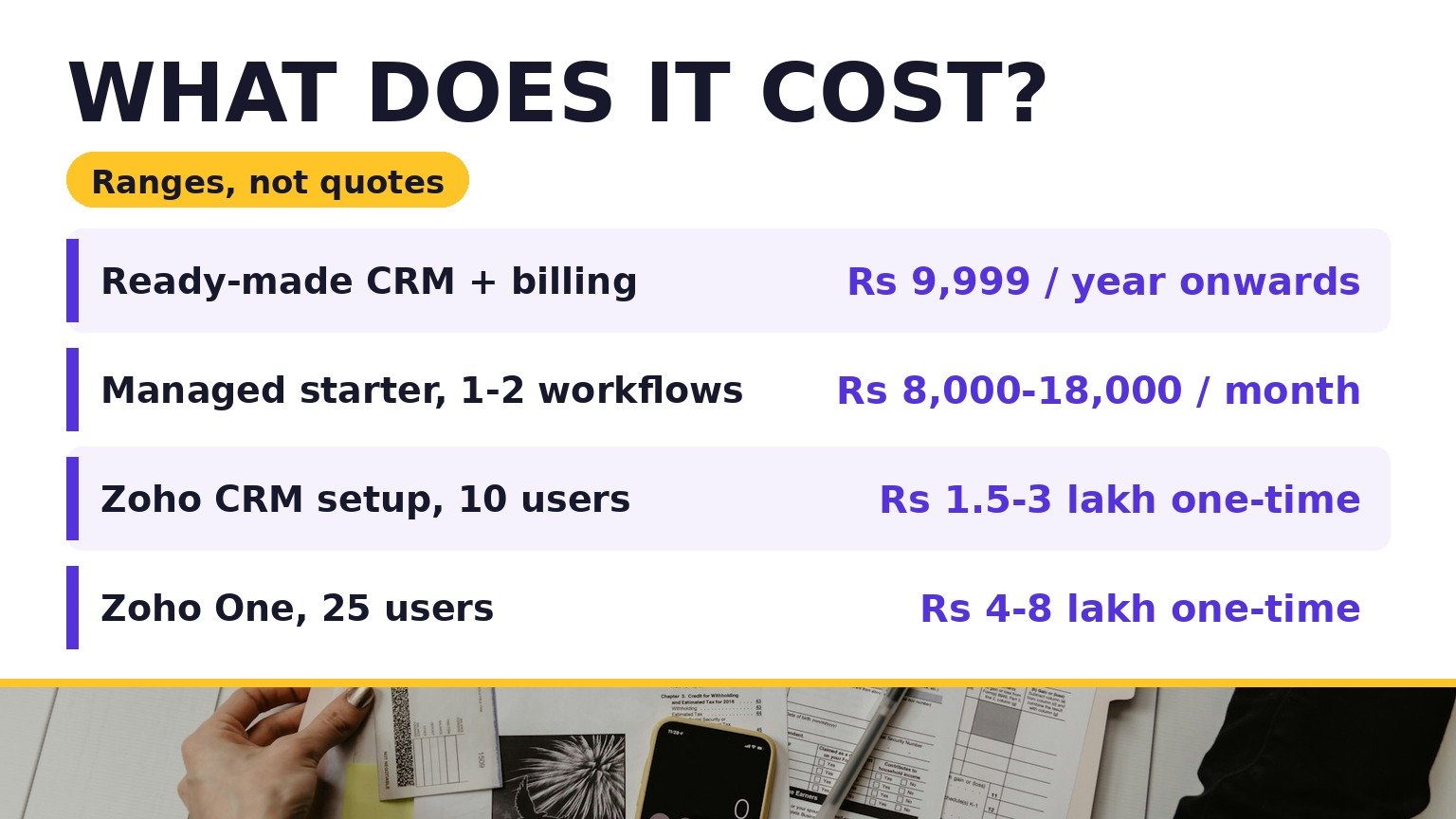
All costs below are published market ranges, not quotes. Ranges, not quotes. Your final cost depends on users, workflows, and custom work. Add 18% GST on agency services.
Managed workflow automation, growth (up to 5 workflows, multi-app)
Around Rs 18,000/month
Managed workflow automation, enterprise or custom
Around Rs 35,000+/month
Zoho CRM implementation, 10 users
Around Rs 1.5 to 3 lakh, 4 to 8 weeks
Full Zoho One setup, 25 users
Around Rs 4 to 8 lakh, 6 to 12 weeks
All-in-one CRM plus GST billing tool
From around Rs 9,999/year
Custom CRM or HRMS build
Around US$15 to 40/hour, fixed quote after discovery
The managed automation ranges above come from RightWebSolution’s published workflow automation page for Mumbai, and the Zoho implementation ranges, with licence prices of around Rs 800 per user per month for Zoho CRM Standard and Rs 749 per organisation per month for Zoho Books Standard, billed annually, come from Biz Systems, a Zoho partner in Mumbai. Licence costs are separate from implementation costs.
The cheapest way to start is usually a ready-made CRM plus billing tool, which keeps year-one costs low while you prove the value. Budget for three things people forget: the licences, the one-time setup and data migration, and training.
What breaks when automation goes wrong?
Automation fails in predictable ways, and all of them are avoidable.
Dirty data. If the same customer is saved three times under three spellings, automation sends three messages, or none. Before you automate, clean your customer list: one record per customer, one phone number, and the source of the enquiry recorded.
Messages that never arrive. WhatsApp and email messages fail when templates are not approved, when numbers are wrong, or when too many promotional messages go out at once. Keep transactional messages, confirmations, reminders, and invoices, separate from promotional messages, and send promotions sparingly. If you want the messaging side done properly, start with a guide to WhatsApp automation for Mumbai businesses.
Consent problems. Under India’s DPDP rules, you need a proper basis to message customers, and customers must be able to opt out easily. Never buy a database of numbers and blast it. Every automated message should go to someone who gave you their number for that purpose, and every message should make it easy to stop.
Automation without an owner. A workflow with no owner rots. Someone on your team must own each automated workflow: check that messages went out, fix the failures, and update the message when your offer changes. Automation removes repetitive work, it does not remove responsibility.
The pre-automation checklist
Run through this list before you spend anything. If you cannot tick at least five of these, fix the gap first.
One source of truth for customers: every customer record lives in one CRM or system, not in five phones and two notebooks.
GST-ready invoicing: your billing carries GST details and you can raise an invoice in a minute.
UPI payment links on invoices, so customers can pay from the message itself.
Consent to message customers, with a clear opt-out in every message.
A named owner for each workflow, who checks it weekly.
Clean data: no duplicate customers, no dead numbers, no missing sources.
One clear measure of success per workflow, such as reply time, invoices paid on time, or no-show rate.
Businesses that skip this list usually end up paying twice: once for the automation, and once to fix the mess it created.
How do you know automation is working?
Measure four numbers, weekly, for the first two months:
Reply time: how fast the first response goes to a new enquiry. The target is minutes, not hours.
Enquiries answered in time: the share of enquiries that got a response the same day.
Invoices paid faster: the average days from invoice to payment.
Hours saved: the hours your team no longer spends on copying, chasing, and reminding.
If reply time falls, invoices get paid faster, and your team reports fewer repetitive tasks, the automation is working. If the numbers do not move in 8 weeks, the problem is usually the process or the data, not the tool.
A realistic timeline: enquiry follow-up and reminders show results in 2 to 4 weeks. Invoicing and reporting improvements show in 4 to 8 weeks. A full multi-workflow setup takes 6 to 12 weeks from decision to steady running.
How much does business automation cost in Mumbai?
Published market ranges start at around Rs 8,000 a month for a starter managed setup with one or two core workflows, around Rs 18,000 a month for growth with up to five workflows, and around Rs 35,000 a month or more for enterprise or custom work. A ready-made CRM with GST billing can start from around Rs 9,999 a year, while a Zoho CRM implementation for 10 users typically runs around Rs 1.5 to 3 lakh. Ranges, not quotes: licences, users, and custom work change the final number, and 18% GST applies to agency services.
What should a small business automate first?
Automate the workflow that loses the most enquiries or cash. For most small businesses, that is enquiry capture and follow-up, followed by GST invoicing and payment reminders. Appointment reminders come next for clinics, salons, and service businesses. Start with one workflow, prove it works, then add the next.
Do I need a CRM before I automate?
Yes, in almost every case. Automation needs one place where customer details live, or it has nothing reliable to work with. A CRM is that place: every enquiry, call, and invoice connects to one customer record. Without it, automation just moves the same mess faster. Choose the CRM first, then automate around it.
Ready-made tools or custom automation: which is right for me?
Ready-made tools suit most small and mid-sized businesses: they are faster, cheaper, and proven. Custom automation suits businesses with unusual processes, high volumes, or integrations no ready-made tool supports. The practical path for most is ready-made tools for standard workflows, with small custom connections where two tools need to talk. Start ready-made, and build custom only when you can name the exact gap.
Will automation replace my staff?
No. Automation replaces repetitive tasks, not people. It handles the copying, reminding, and chasing, so your team spends time on conversations, problem-solving, and selling. In practice, most Mumbai businesses that automate do not cut staff; they handle more customers with the same team.
How long does it take to see results?
Enquiry follow-up and reminders typically show results in 2 to 4 weeks: faster replies and fewer missed enquiries. Invoicing and payment improvements usually show in 4 to 8 weeks. A full setup with several workflows takes 6 to 12 weeks to run steadily.
Talk to Digital Dhatu before you automate the wrong thing
The most expensive automation is the one that automates the wrong workflow, or the one that sits unused because nobody on the team adopted it. A short conversation before you spend anything can save you both mistakes.
Digital Dhatu helps Mumbai businesses, clinics, real estate teams, retailers, and service firms, pick the right workflows, connect their CRM, WhatsApp, billing, and reporting, and measure the results. We start with your biggest leak, not the flashiest tool.
Book a free consultation and bring your messiest workflow, the one that eats hours every week. We will tell you honestly whether it should be automated, what it would take, and what it should cost. Contact Digital Dhatu today.
Share:
Want results like these for your business?
Talk to our team for a free consultation, with no obligation.
Start with the free foundations: a complete Google Business Profile with real photos and correct hours, a WhatsApp catalogue of your stock, and 3 to 5…
A basic AMC covers repairs when things break, while managed IT support prevents most breaks in the first place: monitoring, patching, backup checks and a helpdesk…
Short answer: Start with the four apps that matter: Google Business Profile, Zomato, Swiggy, and Instagram. A single-outlet cafe spends around Rs 35,000 to 80,000 a…