Lead Generation for Mumbai Businesses: How to Get Qualified Enquiries, Not Just Leads
By Ayush DubeyNovember 14, 202613 min read
Short answer: A lead is a name and a number. A qualified enquiry is a person with a budget, a location, a timeline and a decision to make — contacted within minutes, not days. Most Mumbai businesses do not have a lead problem; they have a qualification and follow-up problem. This guide covers the 6 checks to run before you spend, the channels in the order that works, 2026 cost ranges, and the follow-up system that stops leads going cold.
The 47 leads that went nowhere
A coaching institute in Andheri spent a month on lead generation in Mumbai and got 47 leads. Nine numbers were wrong. Eleven had filled the form by mistake, or for a course the institute does not run. Fourteen never picked up. Four asked for a price and vanished. Nine booked a counselling session. Two joined.
The ads worked. The form worked. What was missing was everything between the form and the sale: who counts, a way to check them quickly, and a follow-up fast enough to catch them while they decide.
What a qualified enquiry actually is
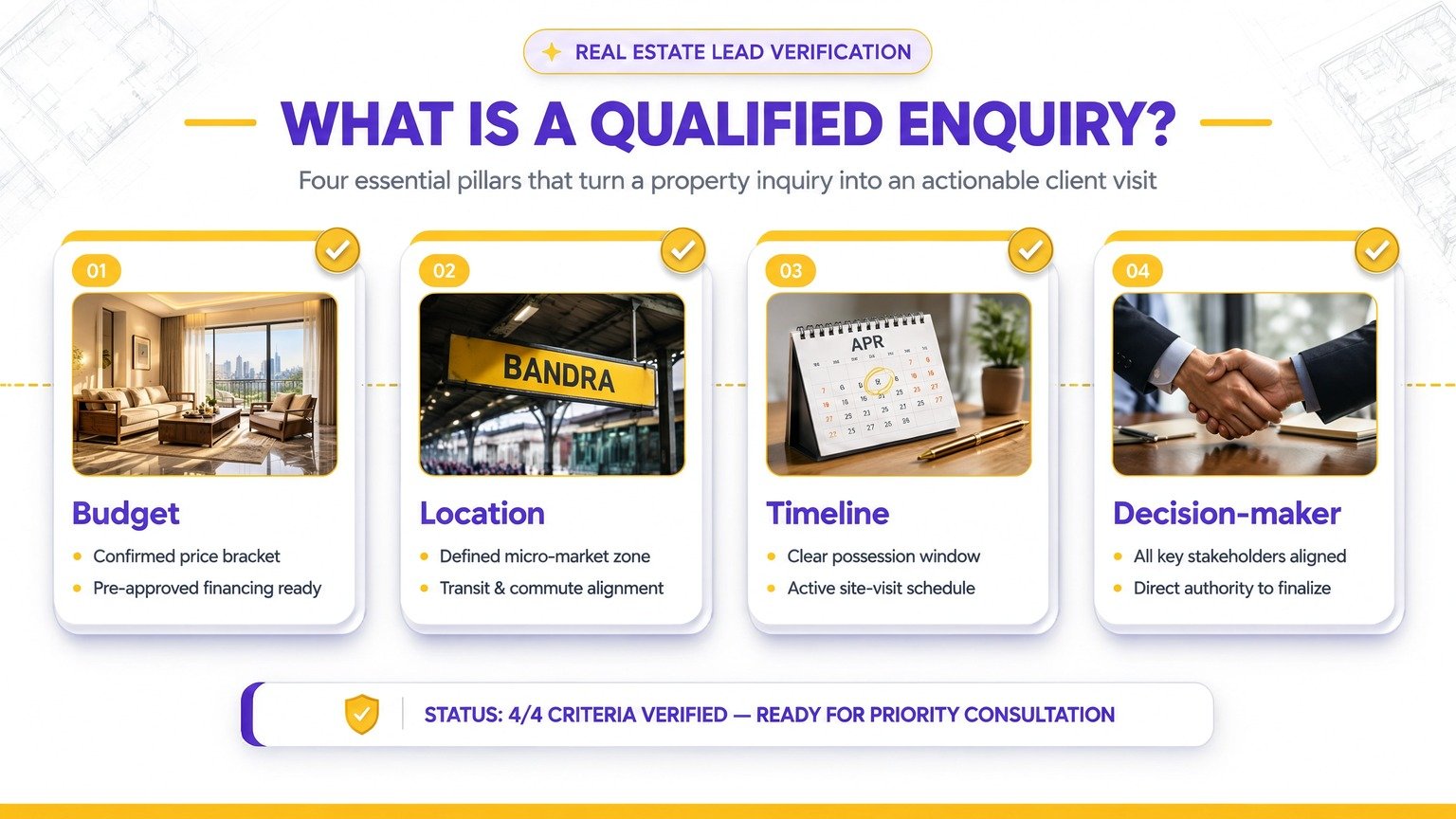
A lead is contact details. A qualified enquiry is contact details plus four facts:
Budget. Can they afford what you sell? A family with a Rs 60 lakh budget for a flat in Borivali is a qualified enquiry for a mid-segment project — a wasted call for a Rs 2 crore project in Worli.
Location. Where are they, and where do they want to buy, study, or get treated? A clinic in Vashi does not need enquiries from Vasai unless the patient will travel — in Mumbai, 20 kilometres can mean two hours in traffic.
Timeline. This week, this month, or “sometime next year”? A person moving in 30 days is hot; a person “just researching” is a future enquiry — worth keeping, not worth a sales call today.
Decision-maker. Are you talking to the person who decides, or someone who will “discuss it at home”? Without the decision-maker, it is not qualified yet.
Score every enquiry on these four: all four is hot — call within minutes; two or three is warm — message and ask the missing question; none is a name on a list. One more filter matters: intent. Someone who searched for a specific service in a specific area beats someone who tapped an ad while scrolling.
Lead generation in Mumbai: the system in plain language
Lead generation is four steps, and most businesses only do the first one.
Step 1: Attract. Someone sees your ad, your listing, or your page.
Step 2: Capture. They leave their details: a form, a WhatsApp message, a call. Keep it easy — name, number, and one qualifying question is enough.
Step 3: Qualify. The step most businesses skip. Within minutes, check the four facts above on WhatsApp or a short call. A two-minute WhatsApp exchange tells you whether this person is worth a 20-minute sales call.
Step 4: Follow up and close. The qualified enquiry goes to the right person, with a next step and a deadline. Every enquiry gets an owner and a next step, or it is forgotten by Friday.
The businesses that get the most from lead generation in Mumbai are not the biggest spenders, but the ones with the tightest steps 3 and 4. Qualify in 10 minutes and call in 15, and you beat a rival that spends twice as much and calls tomorrow.
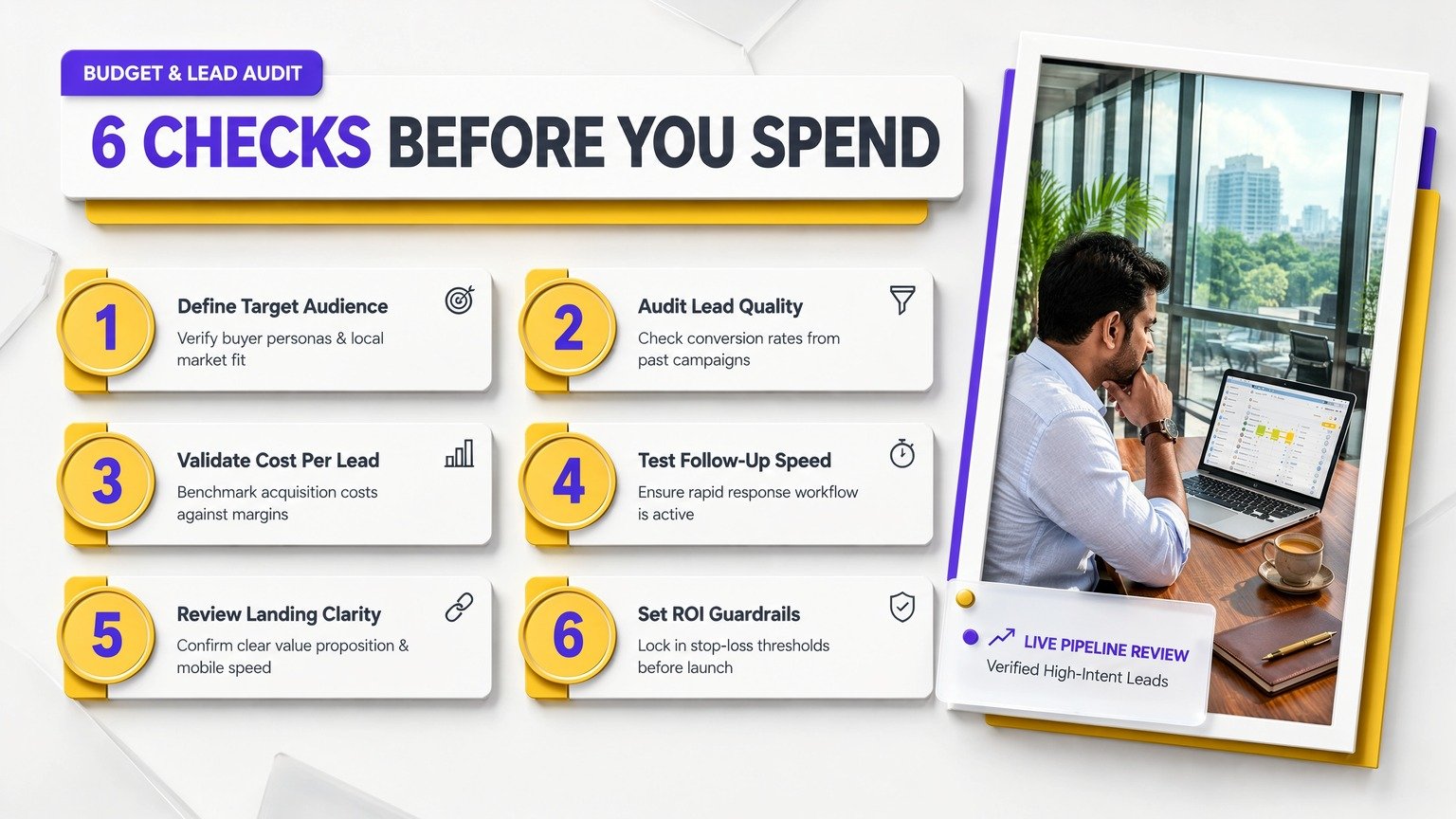
The 6 checks before you spend a rupee
1. Can you say who a good enquiry is — in one sentence?
“We want homeowners in Thane and Mulund, budget Rs 80 lakh to Rs 1.2 crore, looking to buy in the next 90 days.” If you cannot write it, your ads will target everyone and your sales team will drown in the wrong people. Write it first, then build the campaign around it.
2. Is your landing page built for one action?
A lead ad that sends people to your homepage is a leak. The page should do one thing: explain the offer, answer the three most common doubts, and ask for the name and number. If it cannot be understood in ten seconds, the ad money is wasted.
3. Do you have a WhatsApp reply ready in under 5 minutes?
The first reply is the highest-value message in the whole system: a greeting, one qualifying question, and a clear next step — written before the campaign starts. Example: “Hi, thanks for messaging! Which treatment are you looking for?” The reply should arrive in minutes, even at 9 PM. That is what WhatsApp automation is for — without it, someone on your team must own the inbox after hours.
4. Does every lead get an owner and a next step?
A lead with no owner is a lead nobody calls; a lead with no next step gets one call and then silence. Before you spend, decide who calls, within how long, and what happens if the first call is missed: a WhatsApp message after 30 minutes, a second call the next morning, a check-in after three days. Write it down — a system nobody wrote down is a system nobody follows.
5. Can you track cost per qualified enquiry, not cost per form fill?
Cost per lead looks small, which is why agencies quote it. Cost per qualified enquiry is the number that matters. If a campaign gives you 100 leads at Rs 200 each but only 10 are qualified, your real cost is Rs 2,000 per qualified enquiry — not Rs 200. Ask for the report that shows qualified enquiries — if your agency cannot produce it, you are buying form fills.
6. Is your follow-up faster than your competitor’s?
In Mumbai, the same customer often enquires with three businesses in one evening. The first useful reply usually gets the visit, the appointment, or the order. Test it yourself: enquire with two competitors tonight and see who replies first. Then make sure your reply is faster and more useful than both — speed is the cheapest advantage in lead generation.
Google, Meta or WhatsApp — which first?
Every agency has a favourite channel. The right first one depends on intent — how ready the person is to buy.
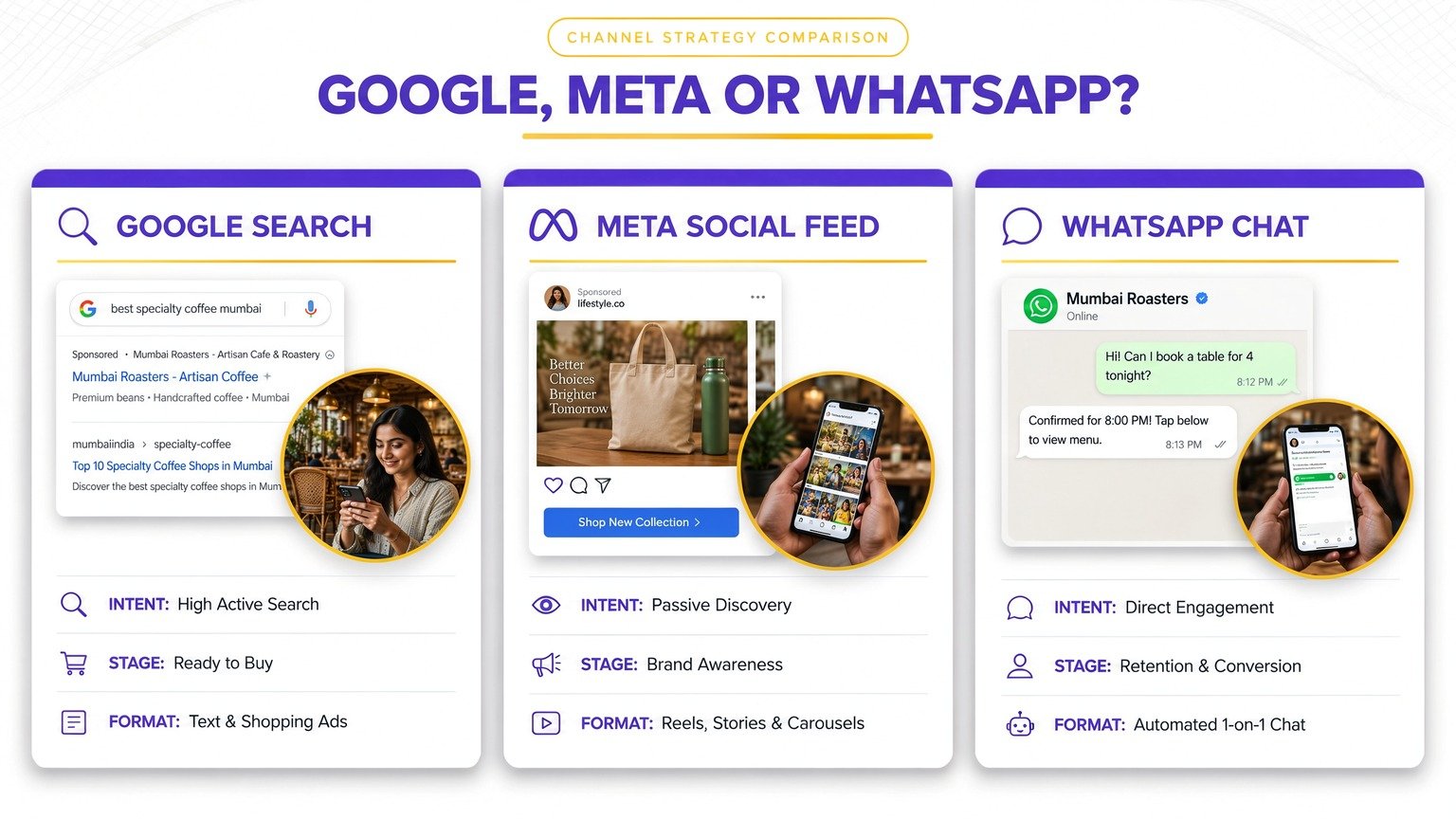
Google first when people are already searching. If someone types “dental clinic in Vashi” or “2 BHK in Powai”, they are choosing between you and three others. Search ads and a strong local listing catch them at the moment of decision — the most expensive lead, and usually the most qualified.
Meta first when people need to be shown the offer. Facebook and Instagram reach people who are not searching yet — a parent who has not started looking for a coaching class, a family that has not decided to move. Meta leads are cheaper but need more qualification, because the person was scrolling, not searching.
WhatsApp first when the conversation is the product. For many Mumbai businesses, WhatsApp is where the sale happens: the ad, the listing, or the referral sends the customer to WhatsApp, and the qualification, the catalogue, the appointment and the payment all happen there. Build the system around it: a WhatsApp Business presence with a catalogue and quick replies, plus an automated first response through the WhatsApp Business Platform, so no enquiry waits until morning.
The order that works for most Mumbai small businesses: Google for the people already searching, Meta for the people who need to see the offer, and WhatsApp where every enquiry gets qualified and followed up. One channel done well beats three done badly. Start where your best customers already find you, then add the next one.
What it costs in 2026
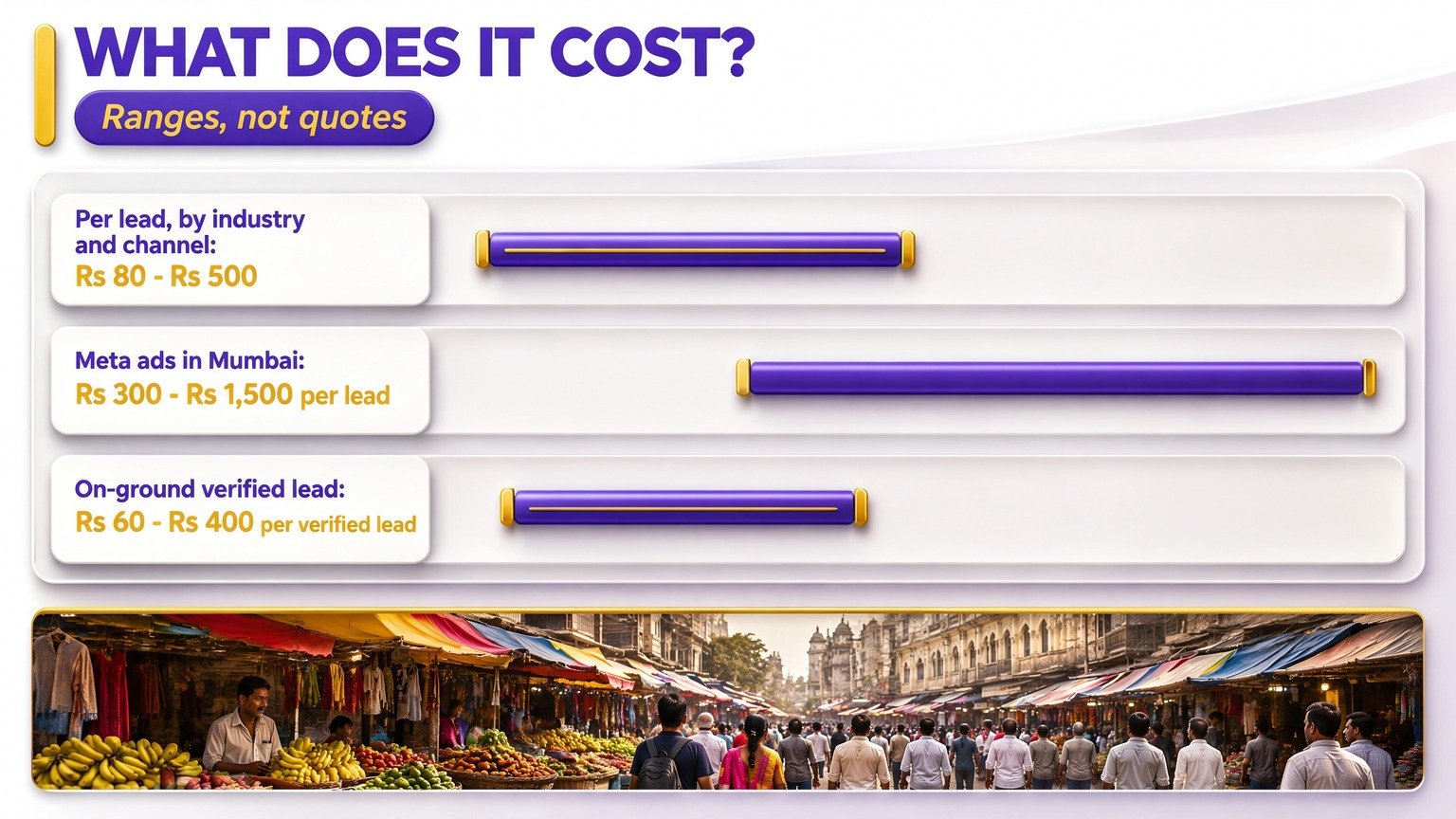
Costs vary so widely by industry and channel that a single number would be a lie:
Per-lead bands by industry and channel. Roughly Rs 80–500 per lead depending on sector and channel — education and healthcare at the lower end, real estate and high-value services at the higher end. Published market ranges, not Digital Dhatu prices.
Verified-lead activation. On-ground verified-lead activation — a lead checked by call or message before it reaches your sales team — is roughly Rs 60–400 per verified lead as a planning band. You pay more per lead, but your team stops calling wrong numbers.
Meta lead generation in Mumbai. Published 2026 benchmarks put it at roughly Rs 300–1,500 per lead, depending on the industry, the audience and the creative. A broad audience with a generic creative sits at the expensive end; a tight local audience at the cheaper end.
The number to watch. The number that matters is cost per qualified enquiry, then cost per sale. A campaign at Rs 500 per lead that produces one sale in ten is cheaper than one at Rs 100 per lead that produces one sale in a hundred. Judge every channel on cost per qualified enquiry.
Ranges, not quotes.
Why most leads go cold
Leads rarely go cold because the customer changed their mind — they go cold because of five fixable failures:
Slow first contact. The enquiry arrives at 8 PM; the first call comes at 11 AM the next day. In those fifteen hours the customer has spoken to two competitors. The fix is a reply in minutes — automated on WhatsApp, with a human call when the office opens.
No second contact. One call, no answer, and the lead is marked “not interested”. Most customers need two or three touches — a call, a WhatsApp message, then a call the next day. A lead that gets one attempt was never really worked.
The wrong person called. A receptionist reading a script cannot answer the question a buyer actually asks. Route the enquiry to the person who can — the counsellor, the sales manager, the doctor’s assistant.
No record, no reminder. The enquiry lives in one person’s phone, or in a chat nobody checks. A shared lead record — a simple sheet with name, number, status, owner and next step — fixes this.
The offer was never clear. The customer enquired, got a vague reply, and moved on. Every first reply should restate the offer, the price range, and the next step: “The 2 BHK starts at Rs 95 lakh, site visits are this Saturday at 11 AM — shall I book you a slot?”
Red flags and mistakes to avoid
Buying lead lists. A list bought online is not an audience. The people on it never asked to hear from you — they will report you, and your number and ads account will suffer. Build your own list, one enquiry at a time.
Counting form fills as success. An agency report that celebrates 500 leads and never mentions how many were qualified is designed to look good. Ask for qualified enquiries, site visits and sales — if those numbers are missing, the campaign is not working.
No qualification question on the form. A form asking only for a name and a number produces the cheapest, weakest leads. One qualifying question — budget range, location, or timeline — costs almost nothing in form fills and saves hours of wasted calls.
Chasing every lead the same way. A hot enquiry deserves a call in minutes; a cold one deserves a polite message and a place on a nurture list. Treating them identically wastes your best sales time on your weakest leads, while your hottest leads wait in a queue.
Running ads to a slow or broken page. If your landing page takes ten seconds to load on a phone, or the form fails on a small screen, you are paying for clicks that can never become leads. A website that loads fast and asks for one thing is the cheapest lead-generation upgrade there is.
How Digital Dhatu works
Digital Dhatu builds lead generation the same way it builds everything else: Understand, then Strategize, then Build, then Launch, then Optimize. First, who a good enquiry is for your business, and where your best customers come from. Then the system — channels in the right order, the landing page, the WhatsApp qualification, the scoring, and the follow-up rules — written down before anything is built. Then the build: the campaigns, the page, the automation, and the shared lead record, so every enquiry lands in one place with an owner and a next step. Launch with one channel, check the cost per qualified enquiry for two weeks, then add the next. Then read the numbers every week.
A lead is contact details — a name and a number. A qualified lead is contact details plus four facts: a budget that fits what you sell, a location you can serve, a timeline for deciding, and the decision-maker in the conversation. All four is worth a call within minutes; none is a name on a list.
How much does lead generation cost in Mumbai?
Published market ranges: roughly Rs 80–500 per lead depending on industry and channel, roughly Rs 60–400 per verified lead for on-ground verified-lead activation, and roughly Rs 300–1,500 per lead for Meta lead generation in Mumbai per published 2026 benchmarks. Ranges, not quotes.
How fast should a lead be contacted?
Within minutes, not hours. The first reply — even an automated WhatsApp message with one qualifying question — should arrive in under 5 minutes. The human call should follow as soon as the office opens. In Mumbai, the same customer often enquires with three businesses in one evening; the first useful reply usually wins.
Why do most leads go cold?
Five fixable reasons: slow first contact, no second contact after a missed call, the wrong person calling, no shared lead record or reminder, and an unclear offer in the first reply. Leads rarely go cold because the customer changed their mind — they go cold because nobody followed up fast enough.
Google, Meta or WhatsApp — which first?
Google first when people are already searching, because intent is highest. Meta first when people need to see the offer before they know they want it, because leads are cheaper but need more qualification. WhatsApp is where the enquiry gets qualified and followed up, whatever channel it came from. Start where your best customers already find you, then add the next one.
How do you measure lead quality?
By cost per qualified enquiry, not cost per lead. Track four numbers every week: total leads, qualified enquiries, response time to first contact, and conversion to appointment or sale. If cost per qualified enquiry falls while sales rise, the system is working.
Final word
A Mumbai business does not lose customers because it has too few leads. It loses them because the leads it already gets are never defined, never qualified, and never followed up fast enough. Fix those three — and the same ad spend starts producing enquiries worth calling.
If you want to see what that looks like for your business, book a free consultation with Digital Dhatu. Call +91 80800 99200, or visit the contact page. Our offices are in Vashi and Andheri West, Mumbai — the consultation comes with a clear plan, not a sales pitch.
Share:
Want results like these for your business?
Talk to our team for a free consultation, with no obligation.
Start with the free foundations: a complete Google Business Profile with real photos and correct hours, a WhatsApp catalogue of your stock, and 3 to 5…
A basic AMC covers repairs when things break, while managed IT support prevents most breaks in the first place: monitoring, patching, backup checks and a helpdesk…
Short answer: Start with the four apps that matter: Google Business Profile, Zomato, Swiggy, and Instagram. A single-outlet cafe spends around Rs 35,000 to 80,000 a…