Mobile App Development in Mumbai: Flutter vs Native, and What It Actually Costs
By Ayush DubeyNovember 17, 202613 min read
Short answer: For most Mumbai businesses, mobile app development in Mumbai works best with Flutter or React Native: one codebase that ships on Android and iOS, costing roughly Rs 2.5 lakh to Rs 12 lakh for a first release, against roughly 40 to 50 percent more for two separate native apps. A focused first release takes about 12 to 14 weeks, and running the app then costs roughly 15 to 20 percent of the build cost a year. This guide covers the three frameworks, Android-only vs both stores, the 7 checks before you pay, and year-two costs.
The clinic in Dadar that kept losing bookings to a phone call
A clinic in Dadar had a simple problem, and it is the reason most owners start looking into mobile app development in Mumbai. Patients booked on the phone, the receptionist wrote the time in a diary, and by evening half the next day’s slots had been double-booked or forgotten. The clinic had a website that listed the timings, but nobody opens a website at 11 pm when a tooth starts hurting. They open an app, or call the next clinic on the list.
She needed one because her customers live on their phones, bookings happen after hours, and a missed call is a lost patient. That is the test for every business considering an app: does it solve a job your customers already do on their phones, every day? If yes, build it. If not, a good website and WhatsApp will do the job for a tenth of the money.
This guide is for the first group: the three ways to build an app, what each costs in 2026, how long each takes, and the questions to ask before you pay.
Flutter vs React Native vs native: what each one actually is
The choice decides the cost, the timeline and how painful every future update will be.
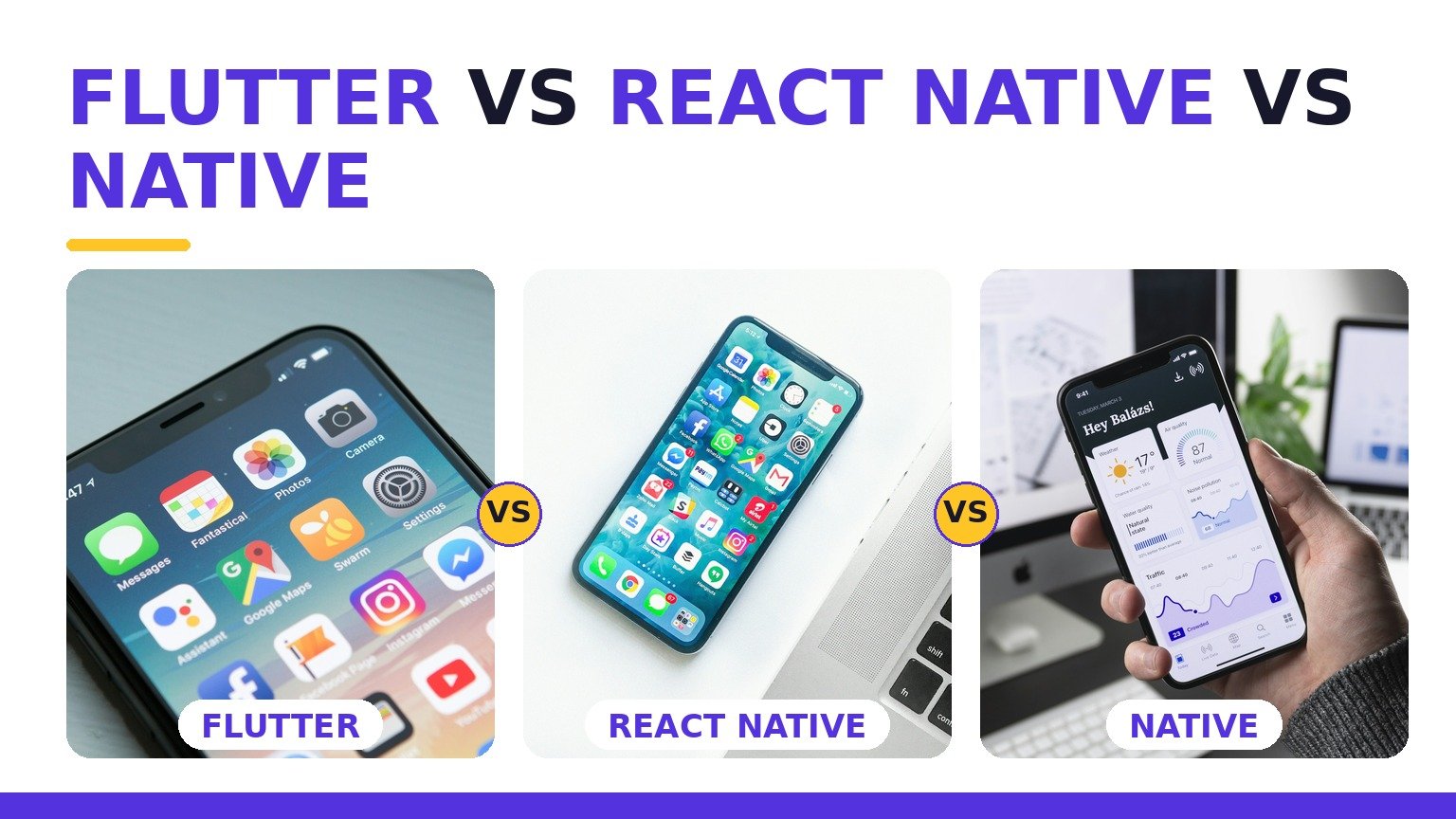
Flutter is Google’s framework for building apps from one codebase: one team writes the app once, and it ships on Android and iPhone. It draws its own interface, so the app looks the same on both phones. For most business apps in 2026, Flutter is the sensible default. The official site is Flutter.
React Native is Meta’s framework and works the same way: one codebase, two stores, built in JavaScript. In practice, honest quotes for Flutter and React Native land within a few percent of each other for the same scope. The difference is the team, not the framework.
Native means two separate apps: Swift for iPhone and Kotlin for Android. Each is built for its own phone, so it is the fastest and smoothest option and can use every phone feature, from Bluetooth printers to background location tracking. The price is that the app layer is written, tested and updated twice, which is why native costs roughly 40 to 50 percent more than cross-platform for the same scope.
Which one fits your business? Decide by who uses the app every day
A clinic, salon or coaching class taking bookings. Customers book, reschedule and pay, and staff manage the day from an admin panel. Flutter or React Native is the right call.
A D2C store or a shop selling on its own app. Customers browse a catalogue, pay by UPI and track delivery. Cross-platform is right again, but read our guide to “ecommerce website development in Mumbai” first: a website with good checkout often earns its money back faster than an app.
A field sales or delivery team. Your staff uses the app all day: orders, routes, delivery photos, attendance. If it must scan barcodes, print from a Bluetooth printer or track location in the background all day, native earns its extra cost. If it is mostly forms and lists, cross-platform is fine.
A housing society or a membership club. Notices, maintenance bills, complaints and visitor approvals, used by residents of every age on cheap Android phones and old iPhones alike. Cross-platform keeps it affordable; the real work is the admin panel, not the app itself.
An on-demand service, a marketplace or a delivery platform. Several kinds of users, live tracking, payments, payouts, ratings and an admin panel that runs the whole business. This is the most expensive category in any framework, and the team matters more than the framework. Ask for a live app you can download, not a slide deck.
Android only, or Android and iOS?
Mumbai runs on Android: in most local businesses, eight or nine customers in ten carry one, so building Android only tempts many owners, and for many businesses it is the right call.
Build Android only when your customers are local and price-sensitive, and when the budget only stretches to one platform done well.
Build both when your customers include iPhone users who pay more, when the app is part of a premium brand, or when your buyers are spread across India and abroad. A clinic in South Mumbai, a D2C brand selling across India and a B2B product used by managers will all meet iPhone users on day one.
What the app must do on day one
Before you sign, check that these five things are in the first release, not promised for later.
Login that works. Phone number login with OTP is what Mumbai customers expect; email and password alone will lose sign-ups.
Payments that work. UPI first, then cards, then cash on delivery where it applies. Test a real payment before launch, not a test payment.
Push notifications that work. A booking reminder, a delivery update, an offer. Notifications are why an app beats a website: the business can reach the customer without waiting for them to open anything.
An admin panel that works. Someone in your office must be able to add a product, change a price, see today’s orders and block a user without calling the developer. Without an admin panel, you do not own the app, you rent the developer.
A handover to WhatsApp. Many customers will still want to talk to a person. A button that opens a WhatsApp chat with the order or booking attached saves more sales than any feature. Our guide to “WhatsApp automation for Mumbai businesses” covers how that handover should work.
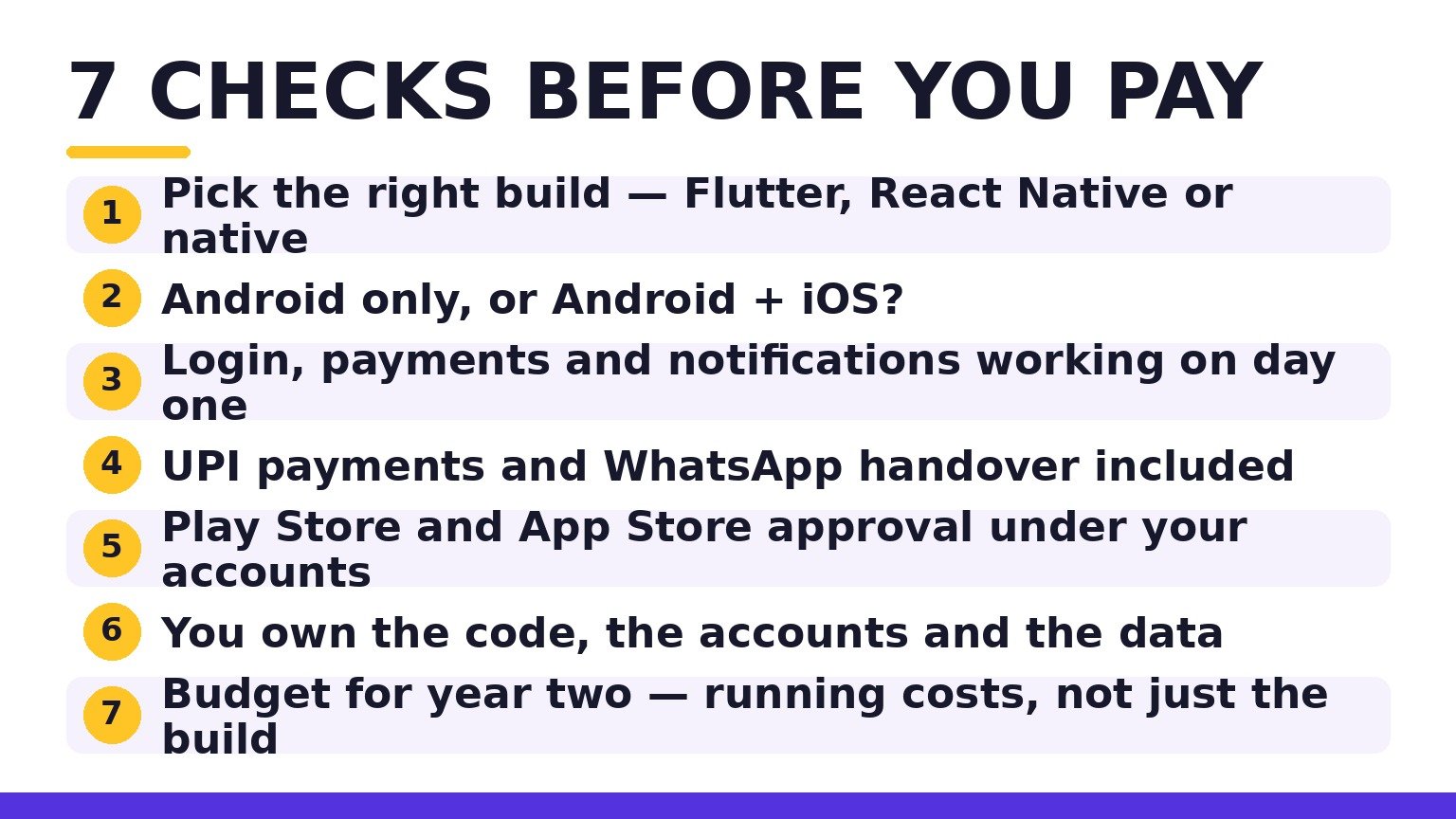
The 7 checks before you pay for mobile app development in Mumbai
1. Can you download and use an app they have already shipped?
Ask for a live app on the Play Store or App Store and download it. If the agency cannot show you one, you are paying to be their practice project.
2. Is the scope written down screen by screen?
The proposal should list the screens, features and what is not included. “App with payment and notifications” is not a scope; a list of 15 screens with named features is.
3. Who owns the code, the accounts and the customer data?
You should own the source code, the store accounts should be in your business name, and the customer data should sit in a database you control. If the agency owns the accounts, you cannot move the app to another team later.
4. Is the backend, admin panel and testing included in the price?
Some quotes cover the app only, with the backend, admin panel and testing arriving as extras. A first release that includes all of them is the honest comparison.
5. What does the app cost to run every month after launch?
Ask for the running cost in writing: hosting, SMS and OTP charges, payment gateway charges, push service and maintenance. Budget roughly 15 to 20 percent of the build cost per year for maintenance alone.
6. How are updates handled, and how fast?
Phones change every year, and an app that is not updated stops working. Ask what a small update costs, how long it takes, and who is on call if the app breaks on a festival weekend.
7. Will they show you progress every week, on a real phone?
You should be able to install a test version on your own phone from week two or three. If you only see screenshots until launch day, you will discover problems when it is too late to fix them cheaply.
Play Store and App Store approval: who owns the accounts
Google Play Store. A developer account costs a one-time fee of roughly Rs 2,100, and Google reviews the app before it goes live, usually within a few days. The account must be in your business name, with your business email and phone number.
Apple App Store. A developer account costs roughly Rs 8,300 every year, and Apple’s review is stricter: it rejects apps that are thin wrappers around a website, apps with broken links, and apps that take payments outside Apple’s system for digital goods. Read the “App Store Review Guidelines” before you approve a design, because a rejection can cost weeks. The account must be in your business name too.
Never publish under the agency’s account: moving the app later is painful, and your ratings and reviews belong to the account that published it. The agency can be added as a user on your account instead.
What it costs in 2026
There is no single price for an app. These are published market ranges for India and Mumbai in 2026, not Digital Dhatu prices. Every figure below is a range, not a quote. For the website itself, see our guide to “website development cost in Mumbai“.
A bare-bones starter or catalogue app. From roughly Rs 5,000 for a defined starter scope, and roughly Rs 40,000 upwards for a small business app built by a professional team. At this level you get a few screens, a catalogue or a simple booking flow.
A startup MVP, cross-platform. Roughly Rs 30,000 to Rs 2 lakh at the lower end of the market, and roughly Rs 2 lakh to Rs 5 lakh for a properly built MVP with login, payments, notifications and an admin panel. A focused first release, 10 to 20 screens, one core flow and a simple admin panel, usually lands around Rs 12 lakh to Rs 18 lakh.
A medium business app. Roughly Rs 5 lakh to Rs 12 lakh: custom screens, multiple user roles, push notifications, payment integration, user profiles and analytics. Most serious Mumbai business apps land here.
A complex or growth app. Roughly Rs 12 lakh to Rs 33 lakh: payments, accounts, a catalogue or bookings, loyalty, analytics, links to your store or CRM, and a proper admin panel. Timelines run 14 to 20 weeks.
An enterprise or platform app. Roughly Rs 25 lakh upwards, and Rs 35 lakh upwards for a marketplace or platform with several user roles, live tracking, offline sync and heavy integrations. Timelines run 20 to 32 weeks.
The cheapest quote is rarely the cheapest app. A quote that leaves out the backend, admin panel, testing and store launch is incomplete, not cheaper. Compare quotes on the same written scope. For the wider build-vs-buy picture, see our guide to “custom software development in Mumbai“.
What it costs to run in year two
This is the gap in most app guides. The build is a one-time cost; running the app is a monthly cost that starts the day it goes live.
Maintenance. Budget roughly 15 to 20 percent of the build cost every year: bug fixes, operating system updates, security patches and small features. Published ranges put monthly maintenance at roughly Rs 25,000 to Rs 1,20,000 depending on complexity.
Hosting and services. The server, database, SMS and OTP charges, push notifications and payment gateway all charge monthly or per use. A small app can run on a few thousand rupees a month; a busy app with thousands of daily users costs far more.
Store fees. Apple charges roughly Rs 8,300 every year to keep the app in the App Store. Google Play charges once.
Your own team’s time. Someone in your business has to answer the enquiries the app creates, update prices, add products and handle complaints. An app nobody manages becomes a dead app with bad reviews.
How long does it take to build an app?
A simple app or MVP. Roughly 6 to 10 weeks from a signed scope to store submission.
A focused first release. Roughly 12 to 14 weeks, including design, backend, admin panel, testing and store launch.
A growth app. Roughly 14 to 20 weeks.
A platform app. Roughly 20 to 32 weeks.
FAQ: Mobile app development in Mumbai
How much does mobile app development cost in Mumbai?
A simple business app usually costs roughly Rs 2 lakh to Rs 5 lakh, one with login, payments and an admin panel roughly Rs 5 lakh to Rs 15 lakh, and a marketplace or delivery platform roughly Rs 15 lakh to Rs 45 lakh. Cross-platform builds cost roughly 30 to 40 percent less than two separate native apps. These are published market ranges, not quotes.
Flutter, React Native or native: which is right for my business?
For most business apps, Flutter or React Native: one codebase ships on Android and iOS, costs less and is faster to update. Choose native only when the app leans heavily on the phone’s hardware, such as Bluetooth printers, barcode scanners or background location tracking all day.
Should I build for Android only, or Android and iOS?
Build Android only if nearly all your customers are on Android and your budget only stretches to one platform done well. Build both if your customers include iPhone users or your buyers are spread across India. With Flutter or React Native you can launch Android first and add iPhone later from the same codebase.
How long does it take to build an app?
A simple app or MVP takes roughly 6 to 10 weeks, a focused first release roughly 12 to 14 weeks, a growth app roughly 14 to 20 weeks, and a platform app roughly 20 to 32 weeks. Timelines stretch when the scope keeps growing or when photos, prices and content arrive late.
What does it cost to run an app every month after launch?
Budget roughly 15 to 20 percent of the build cost per year for maintenance; published ranges put monthly maintenance at roughly Rs 25,000 to Rs 1,20,000 depending on complexity. Add hosting, SMS and OTP charges, payment gateway charges and the Apple annual fee of roughly Rs 8,300. Ask for the first year’s running cost in writing before you approve the build.
Who owns my app, my code and my customer data?
You should. The source code, the store accounts and the customer database should all be in your business name, with the agency added as a user where needed. Get this in writing before the build starts, so you can move to another team later without losing the app or its reviews.
Talk to Digital Dhatu before you pay for an app
An app is a serious investment, and the most expensive mistake is building the wrong one. Bring your idea to a “free consultation” and we will tell you honestly whether you need an app, a better website, or WhatsApp and a booking flow. If an app is right, we will show you the scope, timeline and running cost before you pay anything. See how Digital Dhatu builds apps on the “website and software development service” page. Digital Dhatu works from Vashi and Andheri West, building apps, websites and automation across Mumbai, Navi Mumbai and Thane.
Share:
Want results like these for your business?
Talk to our team for a free consultation, with no obligation.
Start with the free foundations: a complete Google Business Profile with real photos and correct hours, a WhatsApp catalogue of your stock, and 3 to 5…
A basic AMC covers repairs when things break, while managed IT support prevents most breaks in the first place: monitoring, patching, backup checks and a helpdesk…
Short answer: Start with the four apps that matter: Google Business Profile, Zomato, Swiggy, and Instagram. A single-outlet cafe spends around Rs 35,000 to 80,000 a…